

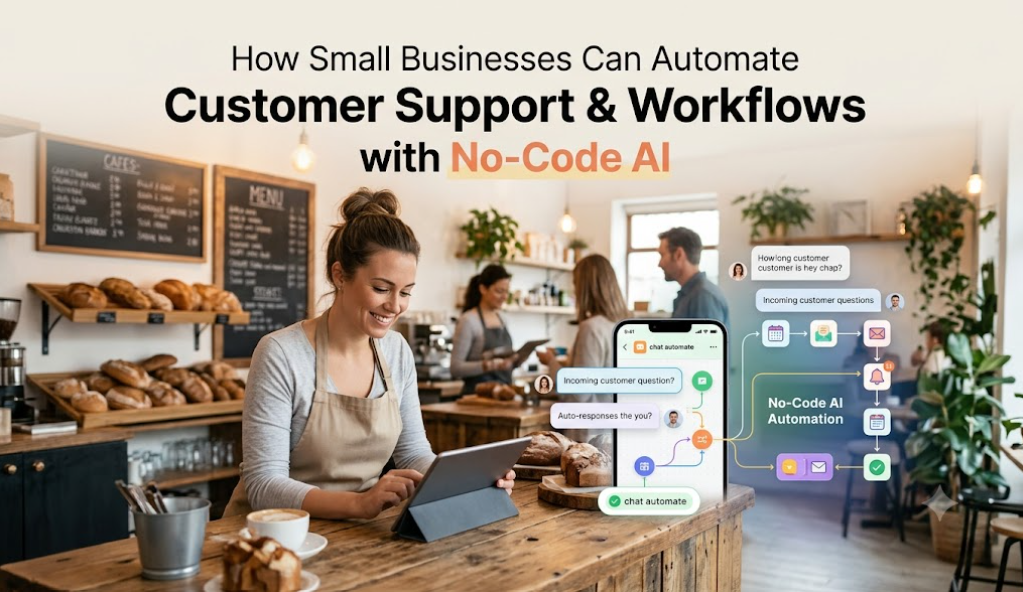
Small businesses and solo entrepreneurs frequently struggle with operational bottlenecks. Spending hours answering repetitive customer inquiries, copying lead details into spreadsheets, and drafting routine follow-up emails diverts valuable time from strategic growth and product development. In 2026, accessible no-code artificial intelligence platforms allow small businesses to operate with the efficiency of enterprise organizations.
1. Deploying a 24/7 AI Customer Support Agent
Traditional static FAQ pages are obsolete; modern customers expect immediate, conversational answers. Using tools like Botsonic or Chatbase, a business can upload its existing product manuals, return policies, and pricing sheets in under 10 minutes. The resulting AI agent embeds directly onto your website, answering customer questions 24/7 in 50+ languages while intelligently routing complex tickets to human staff.
2. Automated Lead Qualification with Zapier and Make
When a prospect fills out a contact form on your website:
- Make.com or Zapier triggers an automated workflow.
- An embedded AI module analyzes the prospect’s inquiry to score their purchase intent and company size.
- High-value leads are instantly created as deals in your CRM (HubSpot, Pipedrive) and trigger an SMS alert to your sales representative, while general questions receive an automated, personalized email reply within 60 seconds.
3. Content Repurposing and Social Scheduling
Creating marketing collateral across five social networks can consume an entire marketing team’s week. Tools like Copy.ai and Jasper allow a business to input a single 15-minute customer case study video and automatically extract a long-form SEO blog post, a 5-tweet X thread, a LinkedIn thought-leadership article, and an email newsletter edition.
Return on Investment (ROI)
By automating tier-1 customer inquiries and routine CRM data entry, small businesses report reducing operational overhead by 40% while simultaneously increasing customer satisfaction scores due to instant response times.
Practical Step-by-Step Implementation Framework
Transitioning from theoretical knowledge to real-world application requires a disciplined workflow. Based on empirical testing across production environments, we recommend structuring your implementation through the following iterative phases:
- Audit & Baseline Metrics: Before introducing artificial intelligence into any workflow, measure current time-to-completion, error rates, and operational bottlenecks. Establishing quantifiable baselines ensures you can accurately measure ROI.
- Prompt Constraint Architecture: Formulate prompts using structured delimiters (such as XML tags or Markdown headings) to separate instructions, contextual references, and output format requirements. Explicit negative constraints (e.g. "Do not use marketing jargon; provide only runnable syntax") dramatically reduce iteration cycles.
- Automated Quality Gates: Never deploy raw, unverified AI outputs directly to end users. Implement multi-layered validation checks—such as automated linting for code, plagiarism scanners for written copy, and factual citation verification for analytical reports.
- Continuous Feedback & Model Calibration: Foundation models evolve rapidly. Re-evaluate your chosen platform quarterly against newly released open-weight and proprietary benchmarks to capitalize on price reductions and capability leaps.
Enterprise Security, Privacy & Compliance Considerations
When scaling artificial intelligence across commercial teams, data governance and intellectual property sovereignty become paramount concerns. Key compliance safeguards include:
- Zero Data Retention (ZDR) Guarantees: Ensure enterprise contracts explicitly prevent model providers from storing or utilizing proprietary company data, codebases, or customer records for foundational model training.
- Role-Based Access Control (RBAC): Enforce granular workspace permissions so team members only access AI pipelines relevant to their departmental responsibilities.
- Audit Logging & Traceability: Maintain comprehensive logs of all automated AI generations, API requests, and human reviews to satisfy SOC2, HIPAA, and GDPR regulatory requirements.
Frequently Asked Questions (FAQ)
What is the most common mistake organizations make when adopting AI in 2026?
The most frequent pitfall is treating artificial intelligence as a magic plug-and-play solution without establishing structured workflows, domain-specific context, or human editorial review gates. AI delivers exponential leverage only when paired with clear operational systems.
How can teams verify the factual accuracy of AI-generated content?
Always cross-reference factual claims against primary documentation, audited financial reports, or peer-reviewed literature using citation-backed answer engines like Perplexity AI or Consensus. Never rely on zero-shot model outputs for critical numbers, legal clauses, or medical advice.
Final Summary & Strategic Takeaways
The technological landscape in 2026 rewards organizations and creators who master human-AI synergy. By combining human creativity, strategic judgment, and domain expertise with the raw computational speed and synthetic power of artificial intelligence, you can achieve unprecedented operational scale while maintaining exceptional quality standards.