
Solving Bloom’s 2-Sigma Problem with Scalable Machine Intelligence
In 1984, educational psychologist Benjamin Bloom published landmark research demonstrating what came to be known as Bloom’s 2-Sigma Problem: students who received one-on-one personal tutoring combined with mastery learning performed two standard deviations better than students taught in conventional classrooms of thirty peers. An average student receiving individual tutoring outperformed 98% of traditionally taught students. For over four decades, Bloom’s finding stood as an agonizing paradox: personalized tutoring was dramatically superior, yet economically impossible to provide to hundreds of millions of children worldwide.
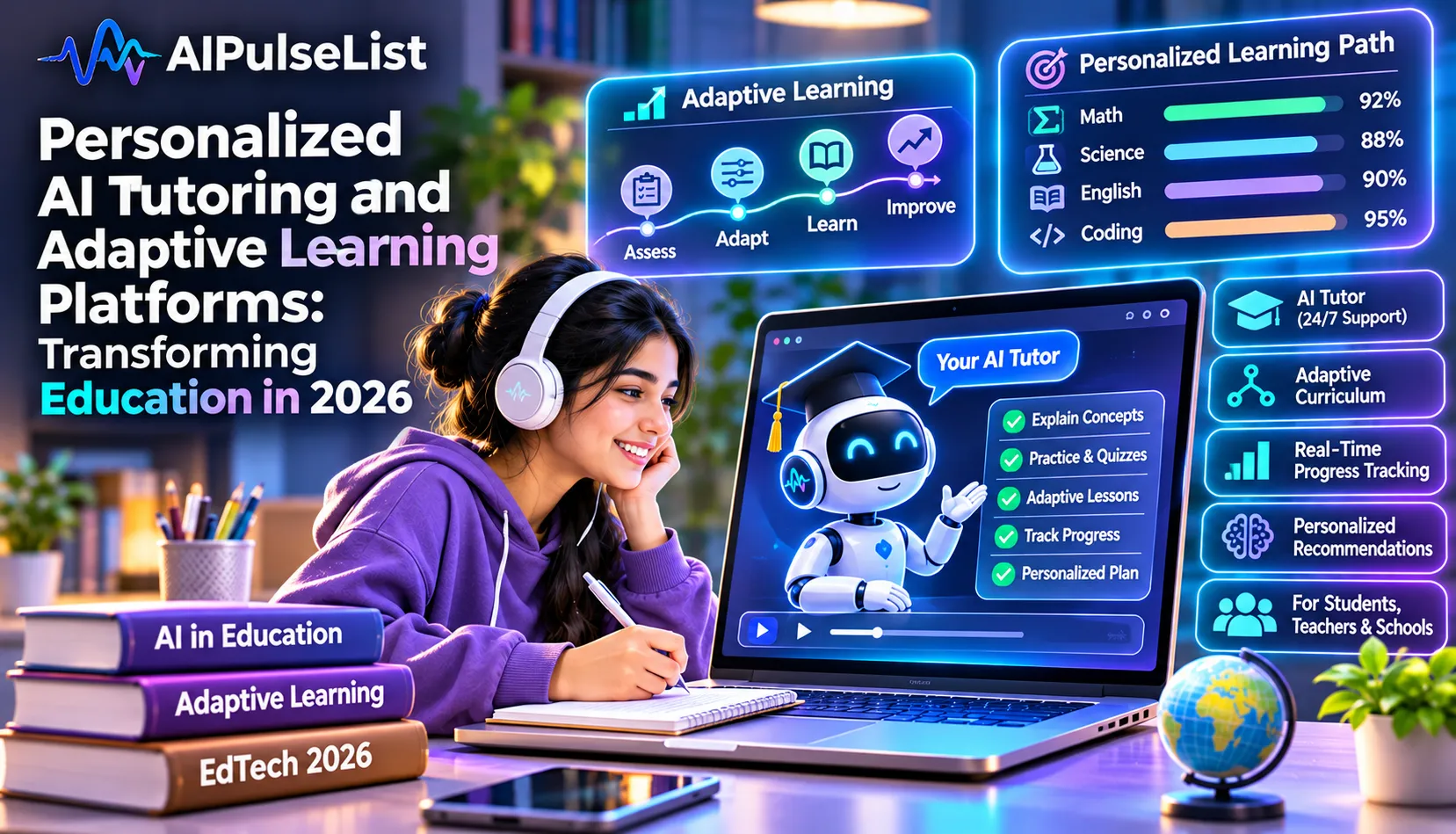
In 2026, artificial intelligence has definitively solved the delivery bottleneck of Bloom’s 2-Sigma Problem. Contemporary adaptive learning platforms and Socratic AI tutors deliver patient, personalized, multimodal instruction to any student with an internet connection. Rather than serving as automated answer dispensers that facilitate academic dishonesty, modern pedagogical AI systems engage students in constructive dialogue, pinpoint conceptual knowledge gaps, and dynamically adjust instructional pacing to each learner's unique cognitive profile.
💡 Pro-Tip for Educators & Learners:
Discover verified tutoring tools, flashcard generators, and interactive STEM simulators in our Education & Tutoring AI Tools Directory.
1. The Anatomy of an Adaptive Socratic AI Tutor
Early attempts at educational chatbots were merely generic prompt wrappers that spit out completed homework answers. Today’s premier educational platforms are built on strict pedagogical foundations:
- Socratic Scaffolding (No Direct Answers): When a student submits a difficult calculus problem or asks for an essay thesis, the AI tutor refuses to output the answer directly. Instead, it asks targeted, scaffolding questions: "What variable represent the rate of change in this equation? What happens to the function as x approaches zero?" This guides the student to derive the solution themselves, building authentic neural pathways.
- Knowledge Graph Mastery Tracking: Educational platforms map entire academic disciplines into structured dependency graphs (Bayesian Knowledge Tracing). If a 10th-grade student struggles with quadratic equations, the AI diagnoses that the root deficiency is actually an unmastered 7th-grade concept in factoring polynomial expressions, generating micro-lessons to remediate the underlying gap.
- Multimodal Visual & Voice Interaction: Students can sketch equations on a tablet screen, speak naturally in their native language, or snap photos of messy handwritten proofs. Real-time vision-language models inspect the student's work line-by-line, pointing out the exact step where an arithmetic error occurred without criticizing the learner.
2. Comparative Matrix: Leading AI Learning Platforms for 2026
We evaluated four leading educational platforms across pedagogical rigor, STEM reasoning, teacher analytics, and accessibility:
| Learning Platform | Core Pedagogical Approach | Subject Strengths | Teacher Oversight Dashboard | Pricing Model |
|---|---|---|---|---|
| Khanmigo (Khan Academy) | Pure Socratic dialogue & mastery learning | K-12 Math, Sciences, AP Courses, History | Comprehensive classroom alerts & lesson planner | Free for verified US teachers / $4/mo students |
| Quizlet Q-Chat | Active recall & spaced repetition conversations | Vocabulary, Languages, Biology, Law | Study set integration & flashcards | Freemium / Quizlet Plus |
| Duolingo Max | Interactive roleplay & explain-my-answer | Foreign Language acquisition & literacy | Automated fluency scoring | $29.99/month |
| Synthesis Tutor | Gamified mental models & first-principles math | Elementary & Middle School Mathematics | Parent progress dashboards | Subscription ($35/month) |
3. Empowering Human Teachers: Automated Grading and Lesson Synthesis
Far from replacing human teachers, AI educational tools are eliminating teacher burnout. In typical public school districts, teachers spend upwards of fifteen hours per week outside the classroom grading essays, drafting lesson plans, and preparing standardized exam assessments. Modern platforms automate the administrative burden:
- Formative Rubric-Based Essay Grading: Systems ingest 120 student essays, evaluate them against a teacher's custom rubric, and draft detailed qualitative feedback notes highlighting thesis clarity, evidentiary support, and grammatical consistency. The teacher reviews and approves every grade in a third of the time.
- Differentiated Lesson Planning: Teachers can instruct the system: "Generate three versions of tomorrow's photosynthesis lab: one for students reading below grade level, one standard version, and an advanced honors inquiry challenge with independent data collection."
- Real-Time Early Warning Systems: Dashboards aggregate student chat interactions and immediately notify the instructor: "Four students are struggling with friction coefficients in homework question #4—review this concept at the start of tomorrow's class."
4. Cognitive Analytics: How Bayesian Knowledge Tracing Works
The core intelligence driving modern adaptive software is rooted in Bayesian Knowledge Tracing (BKT) algorithms. Rather than grading students on a blunt percentage (e.g., 78% on a test), BKT models maintain continuous probabilistic estimates across hundreds of discrete sub-skills.
Every time a learner answers a prompt, the algorithm updates four fundamental parameters: prior knowledge probability, transition probability (the chance of learning the concept after a step), guess probability, and slip probability (accidental errors on known concepts). When a student demonstrates consistent 95% mastery confidence, the platform seamlessly escalates the challenge level, preventing both boredom and cognitive overwhelm.
5. Safeguarding Equity and Privacy in Educational AI
Deploying AI in educational institutions requires adherence to strict ethical and legal safety boundaries:
- FERPA & COPPA Compliance: Student data, conversation logs, and diagnostic scores must be strictly protected under zero-retention enterprise agreements. Student data cannot be used to train commercial models or build advertising profiles.
- Algorithmic Hallucination Mitigation: Educational models must be constrained by deterministic curricular databases, ensuring the AI never invents historical dates or inaccurate scientific formulas during study sessions.
- Combating the Digital Divide: Educational systems must be optimized for lightweight low-bandwidth devices (such as entry-level Chromebooks and mobile smartphones) so that students in underfunded districts enjoy the same high-tier personal tutoring as students in elite private academies.
Frequently Asked Questions (FAQs)
Does using AI tutors discourage students from developing critical thinking?
When properly configured with Socratic protocols, AI tutors enhance critical thinking. Unlike search engines that deliver immediate answers, Socratic tutors challenge students to articulate their reasoning, defend their conclusions, and learn through guided self-discovery.
Can AI tutors help neurodivergent learners (ADHD, Dyslexia)?
Yes. AI tutors offer limitless patience, never expressing frustration when a concept must be explained seven times. They can adapt explanations into visual metaphors, dyslexia-friendly typographic formatting, or bite-sized auditory dialogues that cater to neurodivergent processing styles.
How do schools prevent students from cheating with AI?
Forward-thinking school districts focus on "process over product" assessments. Rather than grading only the final take-home essay, teachers assess live in-class oral defenses, Socratic discussion transcripts, and revision history timelines.
Can AI tutors translate complex educational concepts into multiple languages?
Yes. Multilingual models allow English language learners (ELL) to ask clarifying questions in their native language (e.g., Spanish, Arabic, Hindi) while learning academic English terminology simultaneously, dramatically accelerating concept comprehension.
Conclusion: The Democratization of Mastery
The realization of Bloom’s 2-Sigma vision represents one of the greatest triumphs of artificial intelligence. By pairing world-class human educators with infinitely patient, adaptive AI tutors, we can ensure that every child—regardless of zip code or socioeconomic background—receives the personalized education required to realize their full human potential.