
The Enterprise Dilemma: Knowledge Grounding vs. Behavioral Adaptation
When organizations set out to build private domain-specific AI applications—such as enterprise internal code copilots, clinical healthcare assistants, or financial audit tools—they inevitably face the most fundamental architectural fork in modern generative engineering: Should we ground our model using Retrieval-Augmented Generation (RAG), or should we fine-tune the model on our private domain corpus?
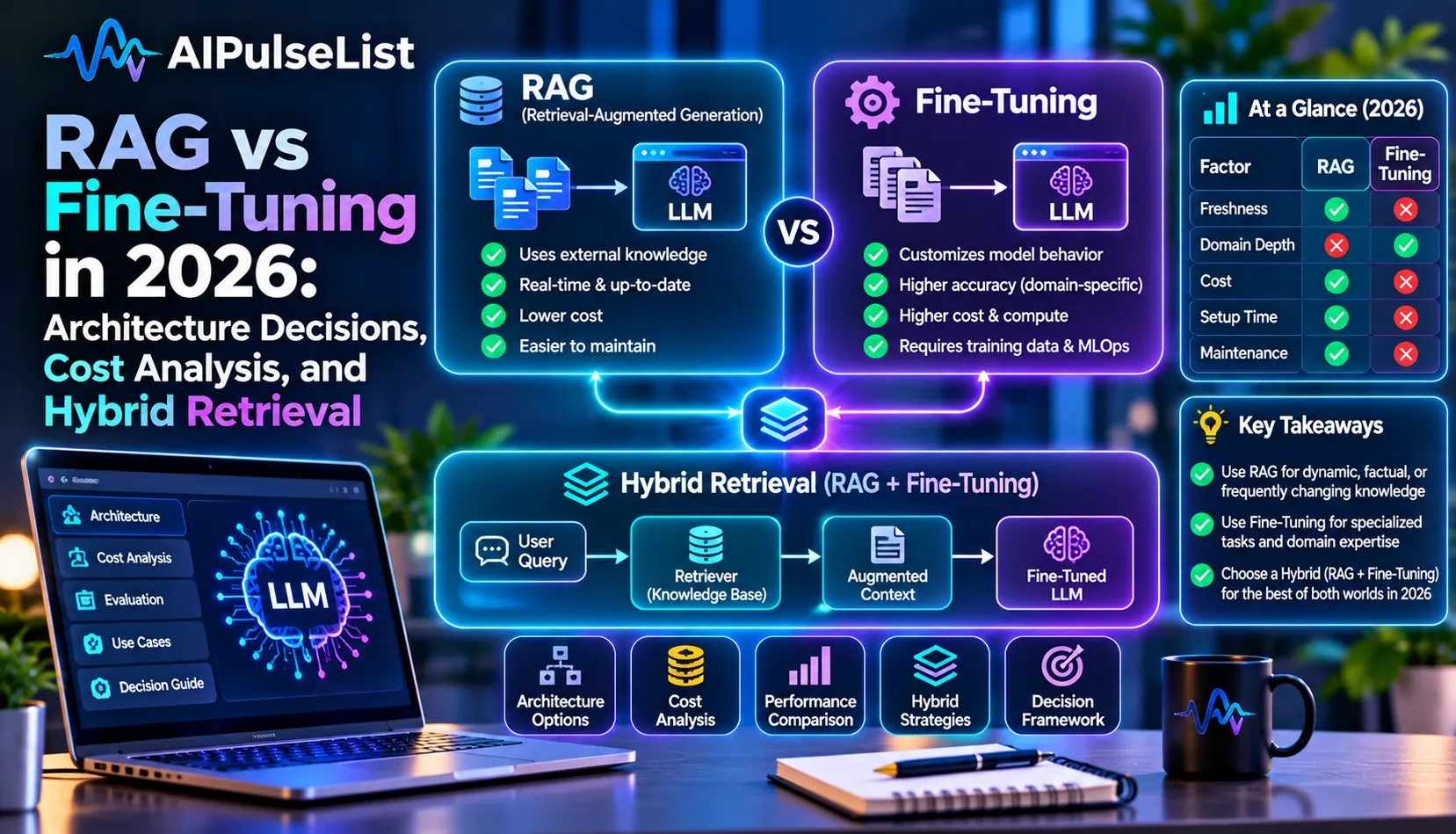
In the early days of 2023, teams often mistakenly viewed RAG and fine-tuning as competing alternatives for the same job. By 2026, empirical benchmark research and production experience have brought clarity: Fine-tuning is for teaching a model form, style, syntax, and specialized task behavior; RAG is for giving a model factual memory, private knowledge access, and real-time verifiable grounding.
💡 Pro-Tip for Software Architects:
Explore vector database engines, orchestration frameworks, and developer copilots in our Coding & Web Development AI Directory and Research & Data Tools.
1. Deep Dive: Retrieval-Augmented Generation in 2026 (From Naive to GraphRAG)
RAG decouples memory storage from model weights. Instead of cramming internal corporate handbooks, Jira tickets, and customer records into the model parameters, documents are chunked, vectorized, and stored in high-performance vector databases (such as Pinecone, Qdrant, Milvus, or pgvector). At query time, the system retrieves relevant context and feeds it directly into the prompt.
In 2026, primitive "naive chunking" has been superseded by sophisticated GraphRAG and Hybrid Sparse-Dense Retrieval:
- Hybrid Search (BM25 + Dense Embeddings): Combines lexical keyword precision (crucial for exact part numbers, error codes, and legal citations) with dense semantic embeddings (which understand conceptual meaning).
- Knowledge Graph Grounding (GraphRAG): Rather than returning disconnected chunks of text, GraphRAG extracts entities, relationships, and global community summaries. If an analyst asks, "What were the recurring supply chain risks across all our European subsidiaries in Q3?" GraphRAG traverses hierarchical knowledge graphs to provide comprehensive global synthesis rather than retrieving random localized snippets.
- Real-Time Verifiability: Every assertion generated by a RAG pipeline carries exact line-level document citations, making it auditable and eliminating hallucinations in high-stakes environments.
2. Deep Dive: Parameter-Efficient Fine-Tuning (PEFT, LoRA & QLoRA)
Fine-tuning involves performing gradient descent updates on model weights using curated question-and-answer pairs or domain demonstration data. Modern production teams rarely retrain full base models; instead, they deploy Low-Rank Adaptation (LoRA) and Quantized LoRA (QLoRA):
- Compact Adapter Modules: LoRA freezes the original billions of base model parameters and injects small, trainable rank-decomposition matrices into the transformer attention heads. This reduces trainable parameters by over 99% while achieving identical domain performance.
- Style & Grammar Adherence: Fine-tuning excels at forcing an LLM to reliably output complex proprietary JSON schemas, conform to strict medical report syntaxes, or master internal esoteric programming languages (e.g., custom DSLs or COBOL dialects) where base models struggle.
- Cost & Latency Reduction: By baking domain terminology and behavioral instructions directly into the model weights, developers can eliminate massive multi-thousand-token system prompts, slashing inference latency and per-query token costs.
3. Decision Matrix: When to Choose RAG vs. Fine-Tuning
Our engineering consultancy created this decision benchmark for evaluating architectural tradeoffs:
| Evaluation Dimension | Retrieval-Augmented Generation (RAG) | Parameter Fine-Tuning (LoRA) |
|---|---|---|
| Dynamic Knowledge Updates | Instantaneous (Update DB index in seconds) | Slow (Requires re-training & validation cycle) |
| Auditable Source Citations | Native & 100% Verifiable | Black-box probabilistic parametric memory |
| Hallucination Rate | Very Low (Strictly grounded in retrieved docs) | Moderate to High on unfamiliar facts |
| Syntax & Schema Adherence | Depends on prompt length & base model | Flawless & Deterministic |
| Inference Latency | Higher (Retrieval hop + large context injection) | Lower (Compact prompts, direct generation) |
| Engineering Upfront Cost | Medium (Vector DB setup & chunking tuning) | High (Curating clean dataset & GPU training) |
4. Cost Modeling: 1 Million Production Queries on AWS vs. Self-Hosted vLLM
To quantify the financial implications of architectural selection, consider an enterprise customer service copilot processing one million requests per month. If using naive RAG with a commercial frontier model, each prompt injects an average of 4,000 retrieved tokens of context.
At $3.00 per million input tokens, processing 4 billion context tokens costs $12,000 monthly in pure inference fees. Conversely, fine-tuning an open-source 8B model (like Llama 3.3 or Qwen 2.5) to understand internal policies allows prompts to shrink to just 350 tokens. Serving this fine-tuned model via self-hosted vLLM on two NVIDIA A10G instances costs approximately $1,400 monthly, achieving an 88% reduction in operating expenditures.
5. The State of the Art: The Hybrid Architecture (RAG + Fine-Tuning)
The highest performing enterprise systems in 2026 do not choose between RAG and fine-tuning; they combine both into a symbiotic hybrid pipeline:
- Fine-Tune for the Task & Tone: The base model is fine-tuned on a few thousand high-quality examples of domain-specific conversations. This teaches the model the exact JSON schemas, medical terminologies, and analytical tone expected by the organization.
- RAG for Live Knowledge & Grounding: At runtime, a GraphRAG pipeline retrieves the latest operational metrics, patient charts, or live compliance policies and injects them into the prompt.
- The Result: The fine-tuned model synthesizes the freshly retrieved documents with zero stylistic drift, deterministic formatting, and full source-citation transparency.
6. The Emerging GraphRAG Architecture: Combining Knowledge Graphs with Vector Embeddings
In highly complex corporate domains—such as pharmaceutical patent discovery or international tax law—traditional vector search struggles with "multi-hop" relational questions. If a query requires connecting four disparate entities across seven internal memos, semantic embeddings often retrieve disjointed fragments that miss the underlying causal chain.
GraphRAG solves this by extracting named entities and relational triples (e.g., [Entity A] -> [Manufactures] -> [Sub-component B]) into structured graph databases like Neo4j. By performing graph traversal prior to vector retrieval, the system provides structured topological context to the LLM, reducing reasoning hallucinations by over 70% in benchmark enterprise evaluations.
Frequently Asked Questions (FAQs)
Can fine-tuning replace RAG if I have a massive dataset?
No. Even when fine-tuned on gigabytes of text, neural networks suffer from catastrophic forgetting and cannot reliably recall specific dates, obscure customer account numbers, or rapidly changing inventory levels. Attempting to use model weights as a real-time database guarantees hallucinations.
How much does it cost to fine-tune an open-source model using LoRA in 2026?
Thanks to optimizations like Unsloth and QLoRA, fine-tuning an open-source 8B or 14B parameter model (such as Llama 3.3 or Qwen 2.5) on a single cloud NVIDIA H100 or A100 GPU can be accomplished in under two hours for less than $10 in compute costs.
What is the biggest pitfall in enterprise RAG implementations?
Poor chunking and retrieval noise. Ingesting arbitrary 500-token chunks often separates questions from their governing context. Implementing semantic chunking, parent-document retrieval, and re-ranking models (such as Cohere Rerank 3) is critical for high retrieval precision.
What is Context Distillation and how does it relate to fine-tuning?
Context distillation is a training technique where an LLM is fine-tuned directly on prompts containing rich RAG context. Over thousands of iterations, the model learns to synthesize retrieved evidence with greater brevity and precision than general-purpose base models.
Conclusion: Strategic Pragmatism in AI Engineering
As enterprise AI infrastructure matures, pragmatic engineering replaces marketing hype. Start by implementing a robust, well-benchmarked hybrid RAG pipeline with high-precision re-ranking. Once your knowledge retrieval is grounded and auditable, introduce targeted LoRA fine-tuning to elevate formatting consistency, reduce latency, and minimize operating costs.