

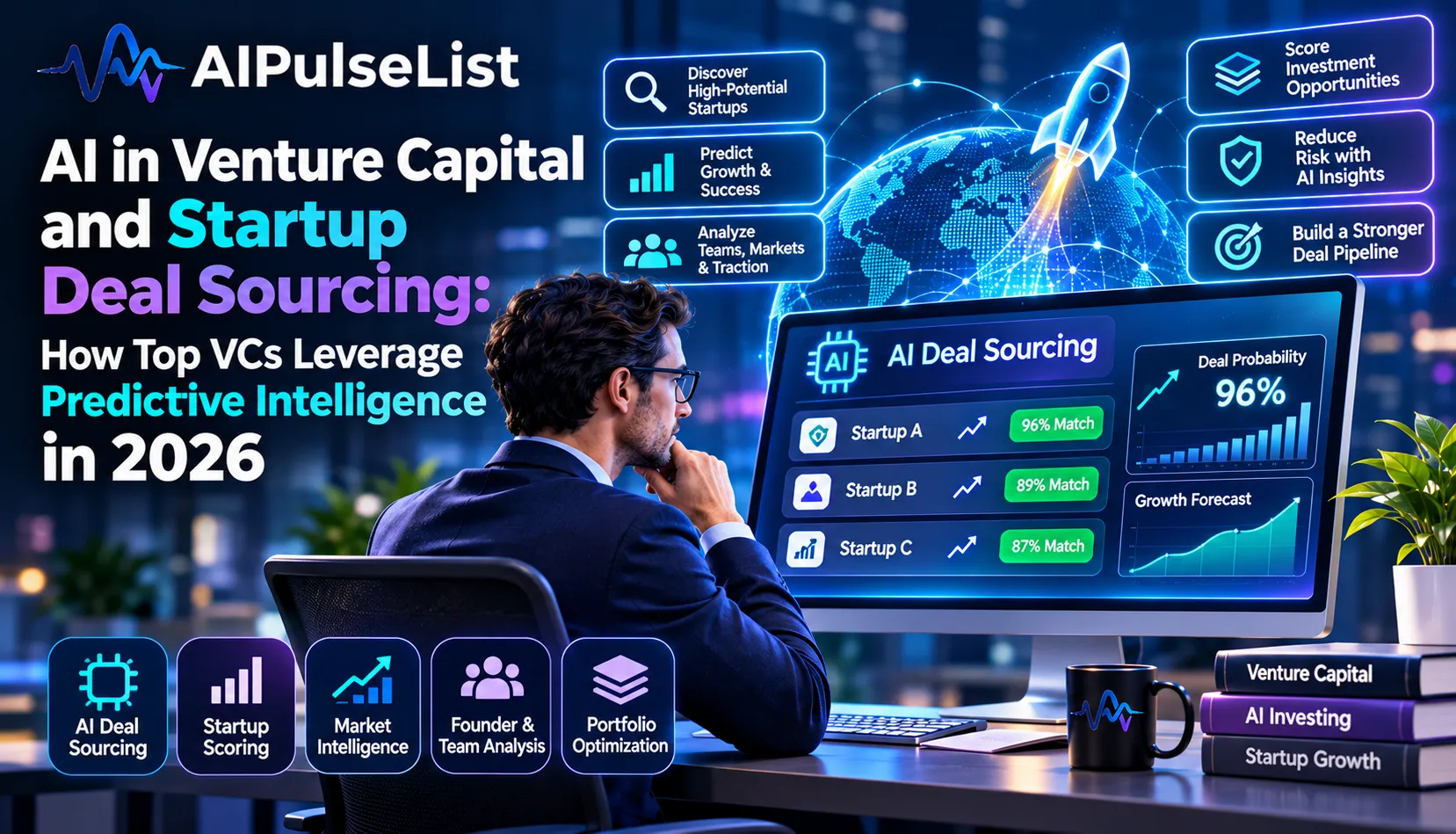
The Algorithmic Dealflow Revolution: Beyond the Ivy League Rolodex
For more than half a century, the venture capital industry operated on a deeply insular social consensus model. Finding promising founders and securing allocations in oversubscribed funding rounds depended on who you met at Stanford mixer dinners, Sand Hill Road golf clubs, or warm email introductions from trusted associates. Sourcing was fundamentally manual, relationship-driven, and structurally prone to severe demographic and geographic biases.
In 2026, algorithmic venture capital has rewritten the rules of early-stage investing. Elite venture funds—from Sequoia and Andreessen Horowitz to boutique micro-funds and algorithmic syndicates—now rely on proprietary machine learning pipelines that scan tens of thousands of data points daily. These automated investment platforms detect breakout startups months before they announce a funding round, grading team backgrounds, open-source adoption curves, customer sentiment velocity, and regulatory moats with quantitative precision.
💡 Pro-Tip for Investors & Founders:
Explore enterprise financial intelligence, automated data scraping, and modeling engines in our Finance & FinTech AI Directory and Research & Data Analysis Tools.
1. The Four Signal Pillars of Predictive Deal Sourcing
How does an algorithm discover a pre-seed startup operating in stealth mode before any press release is published? Modern venture intelligence engines aggregate and cross-correlate four primary signal categories:
- Talent Migration & Executive Departure Tracking: Machine learning scrapers continuously monitor LinkedIn, GitHub, and corporate registry filings. When three senior staff research scientists simultaneously leave OpenAI, Google DeepMind, or Apple to incorporate a Delaware C-Corp with names referencing neural architectures, alerts trigger on investment committee dashboards within hours.
- Developer & Open-Source Telemetry: For developer tooling and infrastructure startups, code adoption precedes revenue. Platforms ingest GitHub star velocity, fork growth, pull-request merge speed, contributor geographical diversity, and npm/PyPI download spikes to identify viral software primitives before the founders ever consider monetizing.
- Web Traffic & App Store Momentum: Data engines monitor DNS registration databases, Cloudflare Radar traffic spikes, Product Hunt upvote momentum, and Substack reader retention curves, flagging sudden non-linear growth inflection points.
- Customer Sentiment & Hiring Signals: Real-time scrapers track employee Glassdoor sentiment, job posting expansion velocity, patent office filings, and enterprise customer reviews on platforms like G2 and Trustpilot.
2. Comparative Benchmark: Leading VC Intelligence Platforms for 2026
We evaluated the leading commercial intelligence systems utilized by contemporary investment teams:
| Platform | Specialized Focus | Data Moat / Sources | Core Capabilities | Access Model |
|---|---|---|---|---|
| Harmonic.ai | Early-stage startup discovery & founder talent | 20M+ companies, live social graph, patent data | Automated outreach alerts & CRM sync | Enterprise SaaS subscription |
| Cyndx | Growth equity & M&A transaction matching | Global financial transactions & cap table signals | NLP concept matching across private companies | Institutional tier |
| Deckmatch | Automated pitch deck inbound processing | Inbound pitch decks (PDF/Notion) | Instant investment memo generation & thesis scoring | Monthly SaaS ($299/mo+) |
3. Automated Pitch Deck Analysis: How AI Screens Inbound Deals
A typical venture partner receives upwards of forty unsolicited pitch decks every single week. Historically, junior venture associates spent hundreds of hours skimming slides to write brief investment summaries. In 2026, specialized multi-modal models handle the initial screening pass:
- Visual & Structural Parsing: The system ingests 15-page slide decks, extracting financial unit economics, market size (TAM/SAM) assumptions, customer acquisition costs (CAC), and customer lifetime value (LTV) projections directly from infographic charts.
- Thesis Alignment & Conflict Checks: The model cross-references the startup against the fund's specific investment mandates (e.g., "Must be B2B software, seed-stage, with female co-founders") and verifies that the company does not directly compete with an existing portfolio investment.
- Synthesis & Investment Memo Generation: In under thirty seconds, the AI drafts a standardized two-page deal memo highlighting key risks, potential valuation benchmarks, and five critical due diligence questions for the partner to ask during the introductory call.
4. The Data Engineering Architecture Behind Algorithmic VC
Behind the sleek dashboards of algorithmic venture firms lies an industrial data engineering stack. High-frequency sourcing systems orchestrate thousands of headless web crawlers and distributed message queues (such as Apache Kafka and Celery) that feed continuous event streams into vector databases and analytical data warehouses.
Every newly discovered startup profile is embedded using high-dimensional dense vector embeddings. If an investment partner specifies an emerging investment thesis—for example, "Post-quantum cryptographic microkernels for autonomous drone fleets"—the vector search engine retrieves semantic matches across unclassified stealth companies within milliseconds, bypassing keyword limitations.
5. Quantitative Due Diligence: Automated Cohort Retention & Unit Economics
Beyond talent signals, modern deal intelligence engines connect directly to anonymized banking and credit card transaction data feeds (such as Second Measure and Consumer Edge) to verify early revenue traction. Machine learning algorithms analyze customer retention cohorts month-over-month, calculating organic repurchase rates and net revenue retention (NRR) without waiting for the founder to disclose internal accounting ledgers. Funds can thus detect whether a viral enterprise software tool is suffering from a hidden "leaky bucket" churn problem long before writing a multi-million-dollar check.
6. The Human Advantage: Where Algorithms Hit a Wall
Despite extraordinary predictive capabilities, leading investors caution against relying entirely on algorithmic decision-making. Certain early-stage parameters remain outside the scope of machine learning:
- Founder Grit & Psychological Resilience: An algorithm cannot measure whether a founding team will persevere when their primary enterprise pilot cancels, or when market regulations shift overnight. High-conviction investing still requires human intuition and personal dialogue.
- Non-Consensus Vision: Machine learning models are inherently pattern-matching engines trained on historical successes. The most transformative startups—like Airbnb, Uber, or SpaceX—initially appeared irrational or commercially impossible based on historical data. Over-relying on algorithmic filtering risks rejecting non-consensus ideas.
- Competitive Founder Winning: Sourcing a deal is only 20% of venture success; winning the allocation against competing term sheets requires relationship building, founder empathy, and firm reputation—skills uniquely preserved by human partners.
Frequently Asked Questions (FAQs)
Can startup founders optimize their company for VC sourcing algorithms?
Absolutely. Founders should maintain public GitHub organizations with transparent release notes, register their Delaware corporate filings accurately, ensure key executives list their company roles cleanly on LinkedIn, and publish public changelogs to register on web momentum scrapers.
Are venture funds using AI to replace junior associates?
Rather than eliminating roles, venture funds have transformed the junior associate role. Instead of spending 80% of their time manually reading cold pitch decks, associates now operate as data engineers and relational ambassadors, focusing on founder interviews and bespoke technical due diligence.
How do funds protect confidential startup data when using AI analysis?
Enterprise platforms utilize private, zero-data-retention API agreements with model providers, ensuring that confidential pitch deck financials and patent details are never used to train public foundation models.
Which famous venture funds have built proprietary internal AI platforms?
Pioneers in internal algorithmic VC include EQT Ventures (with their proprietary platform 'Motherbrain'), SignalFire (with 'Beacon'), and Coatue Management, all of whom have publicly attributed multi-billion dollar exits to proprietary signal detection.
Conclusion: The Era of Data-Driven Conviction
Algorithmic deal sourcing has democratized startup discovery, shining a light on brilliant technical founders regardless of geographic location or personal pedigree. In 2026, the world's best investors combine quantitative machine learning signals with qualitative human conviction, building the future of innovation faster and more equitably than ever before.