

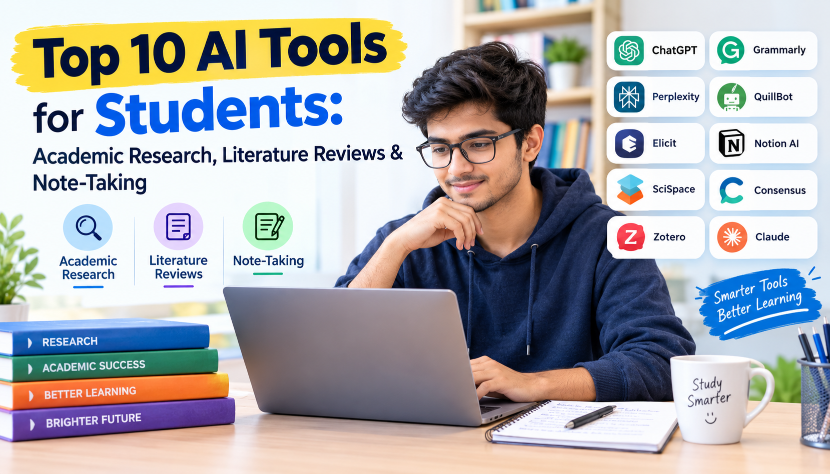
Academic life has transformed dramatically. Between preparing for examinations, drafting research papers, reading hundred-page weekly reading lists, and collaborating on group projects, students today face unprecedented workloads. Fortunately, a new generation of artificial intelligence tools allows students to research deeper, comprehend dense academic literature faster, and organize notes without committing academic dishonesty or plagiarism.
1. Consensus: Evidence-Based Science Search
Rather than relying on generic search engines where SEO spam and commercial advertisements cloud results, Consensus queries over 200 million peer-reviewed research papers. Its proprietary "Consensus Meter" scans scientific abstracts and tells you the exact percentage of published studies that agree, disagree, or remain neutral on questions like "Does intermittent fasting improve insulin sensitivity?"
2. Elicit: The Automated Literature Review Partner
Drafting the literature review section of a thesis or term paper used to require days of manual indexing. Elicit automates this workflow: type your research topic, and it generates a structured comparison matrix extracting the methodology, participant sample size, key findings, and study limitations across relevant academic journals.
3. ChatPDF: Conversational Document Comprehension
Dense academic textbooks and government whitepapers can be overwhelming. With ChatPDF, you can upload any PDF and ask direct questions such as "Summarize the author’s primary critique in Chapter 3". Every response includes clickable page number citations, allowing you to verify the exact passage before referencing it in your paper.
4. Notion AI: Centralized Academic Second Brain
Notion remains the gold standard for student workspace organization. With Notion AI, you can highlight lecture notes to generate instant flashcards, extract action items from group study meetings, and run semantic Q&A across an entire semester’s worth of coursework notes.
5. Perplexity AI: Fact-Checked Web Research
When studying current affairs, economic trends, or historical timelines, Perplexity AI delivers concise, synthesized answers with hyperlinked footnote citations for every single factual statement, making it easy to build your reference bibliography.
6. Speechify: High-Speed Auditory Learning
Students with heavy reading loads or dyslexia rely on Speechify to convert PDF textbooks and digital articles into lifelike audio. Listening at 2x to 3x speed while commuting or working out allows students to absorb course readings in half the time.
7. Otter.ai: Never Miss a Lecture Detail
With permission from instructors, Otter.ai transcribes classroom lectures in real time, automatically labeling speakers, snapping screenshots of presentation slides, and generating a concise summary highlighting key examination concepts.
8. Grammarly: Academic Tone and Clarity Enhancer
Beyond traditional spellcheck, Grammarly ensures your essays maintain formal academic rigor. It identifies passive voice overuse, vague arguments, and repetitive phrasing, ensuring your thesis reads with authoritative scholarly precision.
9. Julius AI: Statistical Modeling for Non-Programmers
For social science and business students enrolled in quantitative research courses, Julius AI eliminates the dread of learning complex Python or R syntax. Upload an Excel or CSV dataset, and Julius generates descriptive statistics, p-values, and publication-ready graphs via plain English prompts.
10. Claude 3.5 Sonnet: The Ultimate Socratic Tutor
Instead of using AI to generate whole essays (which violates university codes of conduct), use Claude 3.5 as a Socratic tutor. Prompt it with: "Quiz me on microeconomic principles, ask me one difficult multiple-choice question at a time, and explain why my wrong answers are incorrect."
Key Takeaway for Ethical Academic Use
Artificial intelligence is most powerful when used as a cognitive bicycle—accelerating comprehension, brainstorming angles, and organizing data—rather than an outsourced ghostwriter. By leveraging these 10 tools responsibly, students can achieve higher academic marks while genuinely mastering their subjects.
Practical Step-by-Step Implementation Framework
Transitioning from theoretical knowledge to real-world application requires a disciplined workflow. Based on empirical testing across production environments, we recommend structuring your implementation through the following iterative phases:
- Audit & Baseline Metrics: Before introducing artificial intelligence into any workflow, measure current time-to-completion, error rates, and operational bottlenecks. Establishing quantifiable baselines ensures you can accurately measure ROI.
- Prompt Constraint Architecture: Formulate prompts using structured delimiters (such as XML tags or Markdown headings) to separate instructions, contextual references, and output format requirements. Explicit negative constraints (e.g. "Do not use marketing jargon; provide only runnable syntax") dramatically reduce iteration cycles.
- Automated Quality Gates: Never deploy raw, unverified AI outputs directly to end users. Implement multi-layered validation checks—such as automated linting for code, plagiarism scanners for written copy, and factual citation verification for analytical reports.
- Continuous Feedback & Model Calibration: Foundation models evolve rapidly. Re-evaluate your chosen platform quarterly against newly released open-weight and proprietary benchmarks to capitalize on price reductions and capability leaps.
Enterprise Security, Privacy & Compliance Considerations
When scaling artificial intelligence across commercial teams, data governance and intellectual property sovereignty become paramount concerns. Key compliance safeguards include:
- Zero Data Retention (ZDR) Guarantees: Ensure enterprise contracts explicitly prevent model providers from storing or utilizing proprietary company data, codebases, or customer records for foundational model training.
- Role-Based Access Control (RBAC): Enforce granular workspace permissions so team members only access AI pipelines relevant to their departmental responsibilities.
- Audit Logging & Traceability: Maintain comprehensive logs of all automated AI generations, API requests, and human reviews to satisfy SOC2, HIPAA, and GDPR regulatory requirements.
Frequently Asked Questions (FAQ)
What is the most common mistake organizations make when adopting AI in 2026?
The most frequent pitfall is treating artificial intelligence as a magic plug-and-play solution without establishing structured workflows, domain-specific context, or human editorial review gates. AI delivers exponential leverage only when paired with clear operational systems.
How can teams verify the factual accuracy of AI-generated content?
Always cross-reference factual claims against primary documentation, audited financial reports, or peer-reviewed literature using citation-backed answer engines like Perplexity AI or Consensus. Never rely on zero-shot model outputs for critical numbers, legal clauses, or medical advice.
Final Summary & Strategic Takeaways
The technological landscape in 2026 rewards organizations and creators who master human-AI synergy. By combining human creativity, strategic judgment, and domain expertise with the raw computational speed and synthetic power of artificial intelligence, you can achieve unprecedented operational scale while maintaining exceptional quality standards.