

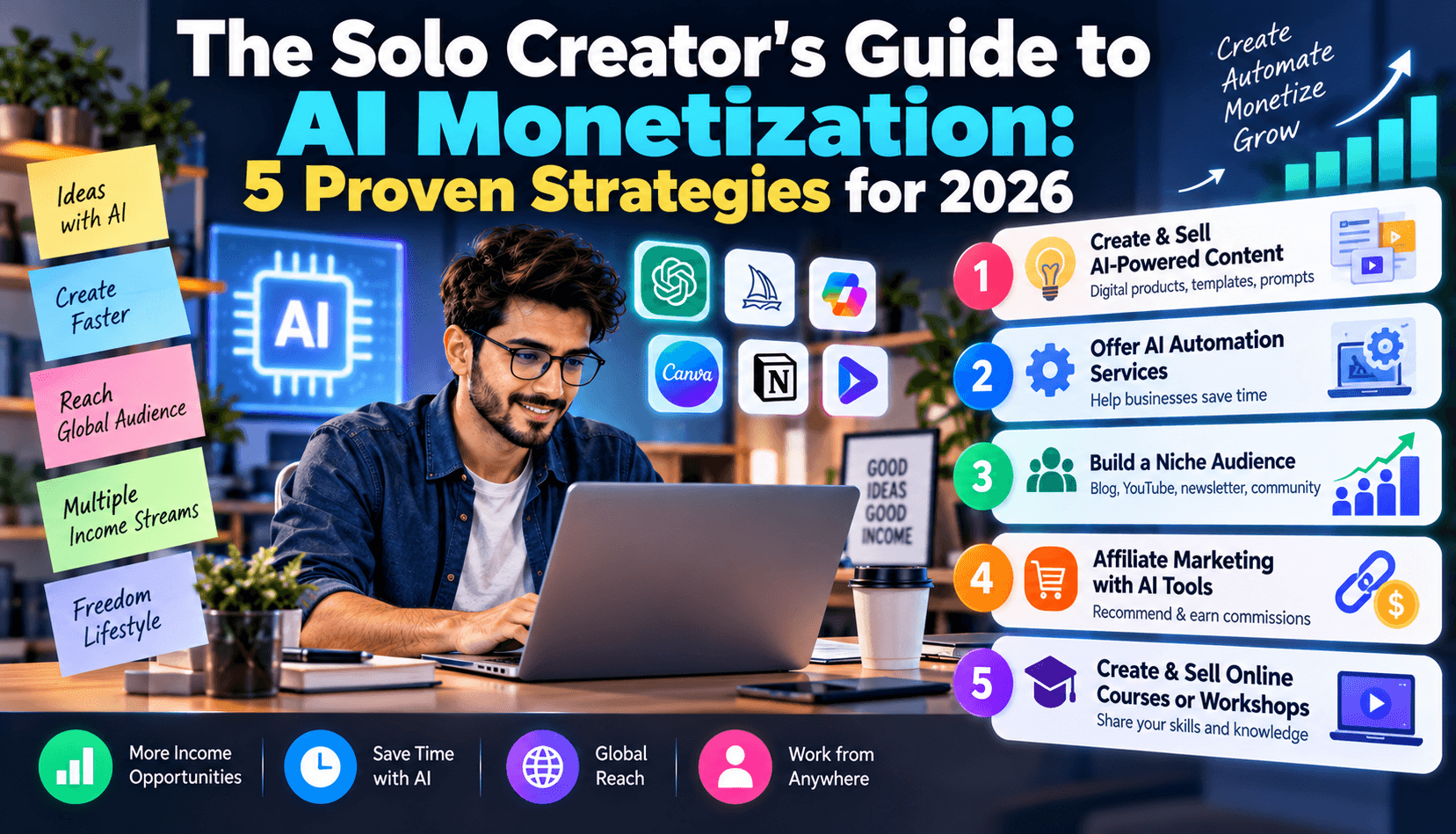
Moving Beyond the Burnout of Traditional Creator Monetization
For more than a decade, the creator economy followed a predictable, exhausting playbook: post content endlessly on social platforms, pray that opaque algorithms grant you impressions, and fight for razor-thin ad-revenue splits or erratic brand sponsorship deals. If you stopped creating for two weeks, your income collapsed to zero.
In 2026, forward-thinking independent creators are abandoning this treadmill. By harnessing artificial intelligence as an operational force multiplier, solo entrepreneurs are transitioning from media personalities into digital asset owners. Rather than trading hours for dollars, they are building scalable software directories, productized automation services, and high-margin digital toolkits.
In this strategic guide, we break down five proven, battle-tested AI monetization blueprints that solo creators are using right now to generate consistent monthly recurring revenue (MRR).
Strategy 1: Niche Curated Directories & Paid Submission Hubs
As the sheer volume of software applications explodes, consumers and business leaders face crippling decision fatigue. Curated resource directories—like AI Pulse—solve this problem by serving as trusted editorial gateways.
How to monetize a niche directory:
- Paid Express Review Submissions: Founders willingly pay $29–$49 to skip editorial queues and have their product reviewed within 24 hours.
- Homepage & Category Spotlights: Charge $99–$299/month for pinned hero banners in high-intent categories (such as developer tools or marketing copywriters).
- High-Converting Affiliate Links: Every time a user clicks through your tracking redirect (e.g. /go/{tool-slug}) and converts on an affiliate partner like Jasper, Cursor, or ElevenLabs, you earn 20%–40% recurring monthly commissions.
Strategy 2: Productized AI Workflow Automation as a High-Ticket Service
Small-to-medium businesses (law firms, real estate agencies, accounting practices, dental clinics) know they need artificial intelligence, but they lack the technical capability to build it themselves. Solo creators who understand tools like Make.com, Zapier, and the OpenAI/Anthropic APIs can package these into productized services:
- Automated Lead Ingestion: Parsing inbound contact form submissions, evaluating lead quality with Claude, and sending custom WhatsApp/email follow-ups in 60 seconds.
- Internal Knowledge Q&A: Indexing a company's private PDF policy manuals and FAQs into a private chatbot for internal staff.
- Pricing Structure: Charge a $1,500 setup fee followed by a $300–$500/month recurring maintenance retainer to monitor API uptime and handle model updates.
Strategy 3: Hyper-Personalized Executive Briefings & Curated Newsletters
In an era where millions of generic AI articles are generated daily, executive decision-makers gladly pay for verified, fluff-free curation. By using local AI models to monitor hundreds of arXiv research papers, GitHub releases, and patent filings, creators can synthesize the three most vital industry shifts into a crisp weekly briefing.
Monetize via Substack or Beehiiv with a freemium model: free tier for broad industry recaps, and $15/month for deep-dive technical benchmarks and investment analyses.
Strategy 4: Bespoke Micro-SaaS Applications Built for Micro-Niches
You do not need to build the next Salesforce to make a fantastic living. Modern coding co-pilots enable creators to launch micro-SaaS tools solving narrow, painful problems in vertical niches:
- An automated invoice reader specifically tailored for Australian trucking fleets.
- A regulatory compliance scraper for municipal plumbing contractors.
- A localized property listing generator for regional real estate agents.
With just 50 customers paying $49/month, you generate $2,450/month in near-100% margin recurring revenue with virtually zero ongoing server costs.
Strategy 5: Interactive Toolkits, Prompts & Automated Templates
If you have spent dozens of hours mastering a specific craft (such as prompt engineering for Midjourney v6, building financial spreadsheets in Excel, or configuring Claude coding environments), package your assets into digital products. Sell prompt libraries, Notion workflow dashboards, and interactive templates through Gumroad or Lemon Squeezy.
Case Study: How a Solo Creator Built a $6,200/Month Passive Engine
Consider the real-world case of an independent tech blogger who launched a vertical AI tool directory focused exclusively on digital marketing applications. Within six months:
- Directory Submissions: 25 tools submitted per month via Express Pass ($29) = $725/mo.
- Featured Category Ads: 4 sponsors paying $150/mo = $600/mo.
- Affiliate Referrals: Outbound clicks through /go/ generating recurring commissions across Jasper and Copy.ai = $3,450/mo.
- Curated Paid Newsletter: 140 premium subscribers at $10/mo = $1,400/mo.
- Total Monthly Revenue: $6,175/mo with less than 10 hours of weekly maintenance.
Monetization Strategy Comparison Matrix
| Monetization Model | Initial Capital Needed | Time to First Dollar | Monthly Revenue Potential | Scalability Rating |
|---|---|---|---|---|
| Curated Tool Directory | $20 – $50 | 2 – 4 Weeks | $1,000 – $8,000/mo | High (Passive) |
| Productized Automation Agency | $50 – $100 | 1 – 2 Weeks | $3,000 – $15,000/mo | Moderate (Client Work) |
| Vertical Micro-SaaS | $50 – $150 | 4 – 8 Weeks | $2,000 – $20,000/mo | Maximum (Infinite) |
| Curated Paid Newsletter | $0 – $30 | 6 – 12 Weeks | $500 – $5,000/mo | High |
| Digital Toolkits & Prompts | $0 | 1 – 3 Days | $200 – $2,500/mo | High (Pure Passive) |
Step-by-Step Financial Model: Calculating Your Break-Even Runway
To transition from a precarious side project into a predictable full-time business, you must rigorously calculate your net contribution margins. Many first-time solopreneurs see $5,000 in monthly Stripe notifications and assume they have made $5,000 in pure profit, only to be ambushed by recurring API bills, server hosting, payment merchant cuts, and customer chargebacks.
Here is the realistic financial anatomy of a healthy $5,000/month AI directory or micro-SaaS:
- Gross Revenue: $5,000.00
- Payment Gateway & MoR Fees (Lemon Squeezy 5% + $0.50 per transaction): -$290.00
- Cloud Hosting & Edge Infrastructure (Vercel Pro + Supabase + Cloudflare): -$45.00
- Third-Party API Consumption (OpenAI / Anthropic inference tokens): -$65.00
- Transactional Email & Analytics (Resend + PostHog): -$20.00
- Estimated Monthly Net Profit: $4,580.00 (91.6% Net Margin)
With gross margins exceeding 90%, digital AI businesses represent one of the highest-leverage asset classes available to modern solo operators.
The 3 Deadly Traps That Kill AI Solopreneurs in Year 1
While the financial upside is immense, the graveyard of abandoned AI projects is crowded. Watch out for these three lethal traps:
- The "Thin Wrapper" Trap: If your product is merely a basic text box that passes a prompt directly to GPT-4o without proprietary workflows, customized datasets, or deep user context, OpenAI or Google can make your tool obsolete with a single model update. Always build defensibility through specialized workflow integrations, custom file parsers, and niche community distribution.
- The Chronic Underpricing Trap: Solopreneurs often price their tools at $5/month because they fear rejection. But businesses do not care about saving $5; they care about saving 10 hours of human labor. Price your business automations at $49, $99, or $299/month. You need far fewer clients to build a life-changing income, and higher-paying business clients churn far less than bargain-hunting consumers.
- Ignoring Churn & Onboarding: Acquiring a subscriber who cancels after 14 days is an operational dead end. Design frictionless interactive onboarding tours, send automated check-in emails, and relentlessly eliminate UX friction during the first 5 minutes of tool usage.
Frequently Asked Questions (FAQ)
Do I need to be a senior programmer to launch these monetization models?
No. For directories, curated newsletters, and digital toolkits, zero coding expertise is required. For automation consulting, no-code visual workflow builders like Make.com and Zapier handle 95% of data plumbing without touching a command line.
How do I prevent churn when foundation models release updates every few months?
Decouple your application architecture from specific models. Use provider-agnostic SDKs so you can hot-swap backend LLMs (such as switching from GPT-4o to Claude 3.7 or DeepSeek) without breaking client workflows. When a newer, faster model launches, your users immediately reap the speed gains without having to change their habits.
How do I handle international payments and tax compliance?
Use merchant-of-record (MoR) platforms such as Lemon Squeezy or Paddle. Unlike traditional Stripe setups where you are legally responsible for calculating VAT, GST, and sales tax across 100+ countries, an MoR acts as the legal reseller and handles all tax compliance automatically.
How do I find my first clients for AI automation consulting?
Look within your existing network or local business chambers. Audit local businesses that have slow lead response times or manual paper forms. Build a working 2-minute Loom video demo showing how an AI workflow answers their customer inquiries instantly, and send it directly to the business owner.
What is the biggest mistake first-time creators make?
Attempting to launch all five strategies at the same time. Pick one specific vehicle—whether it is a curated directory or an automation service—and execute relentlessly until you generate your first $1,000 in monthly recurring revenue.
The Bottom Line
The creator economy is shifting from attention generation to asset ownership. By picking one focused monetization model and leveraging modern AI co-pilots, solo operators can construct enduring, high-margin digital businesses that generate revenue around the clock.