

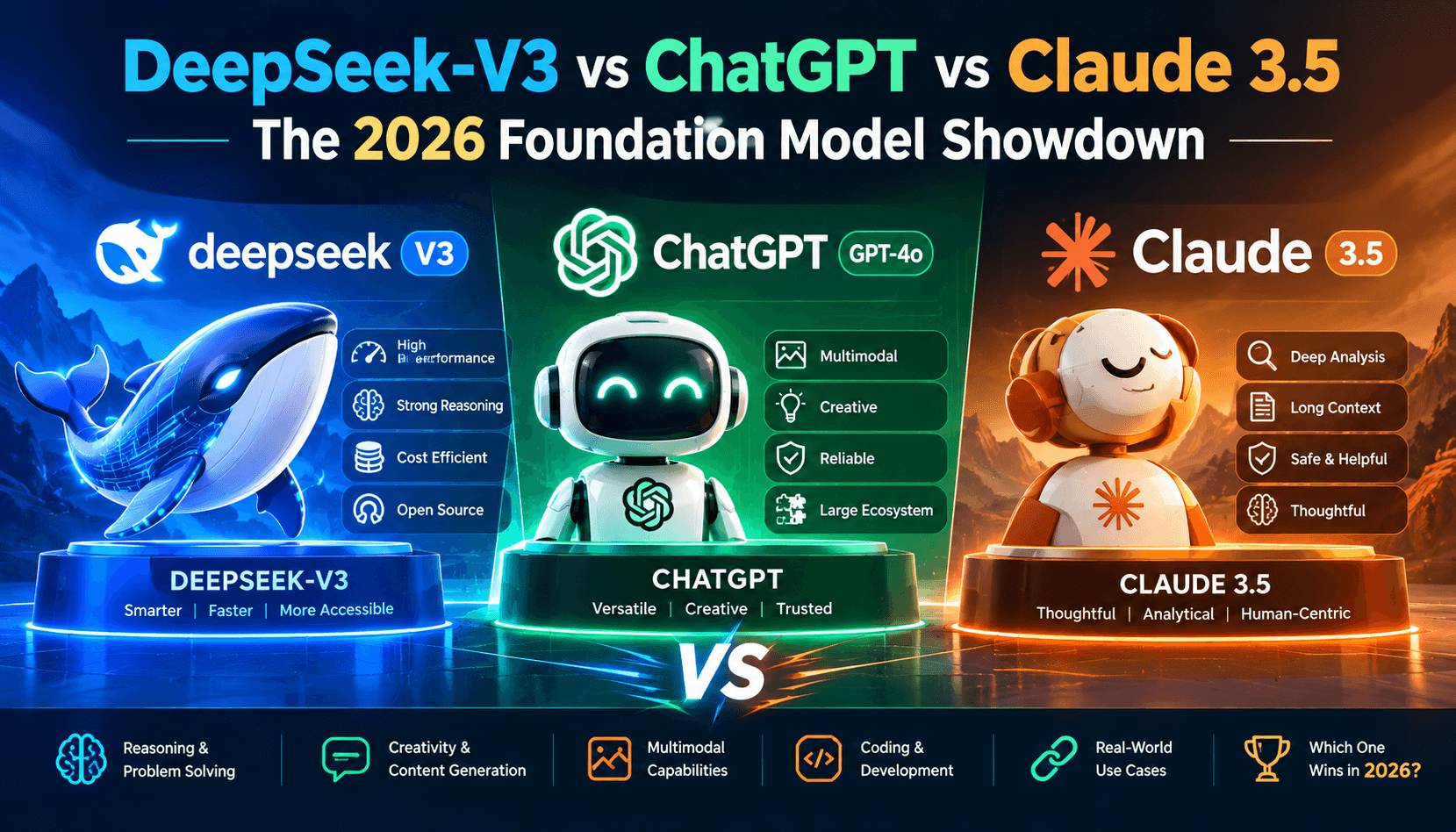
The landscape of artificial intelligence has entered a hyper-competitive era in 2026. For nearly two years, OpenAI and Anthropic held a near-duopoly over frontier-grade cognitive reasoning. However, the release of DeepSeek-V3 and DeepSeek-R1 has sent shockwaves through the technology industry by demonstrating that open-weights models trained at a fraction of Silicon Valley compute budgets can rival proprietary giants.
1. Architecture and Parameter Economics
To understand the divergence between these frontier systems, one must examine their underlying architectural philosophy:
- DeepSeek-V3 (Mixture-of-Experts): Operates with 671 billion total parameters, yet activates only 37 billion parameters per token. This sparse routing achieves lightning-fast inference and enables API pricing as low as $0.14 per million tokens.
- Claude 3.5 Sonnet (Dense Transformer): Renowned for its unparalleled human-like prose, deep architectural reasoning, and a massive 200,000-token context window that retains memory with near 100% needle-in-a-haystack retrieval accuracy.
- ChatGPT / GPT-4o & o1 (Multimodal & Reasoning): Combines multimodal real-time audio/vision processing with specialized chain-of-thought models (o1) that spend deliberate compute time "thinking" before providing answers to complex mathematical and scientific questions.
2. Coding & Software Engineering Benchmarks
Software development remains the primary proving ground for frontier LLMs. In real-world enterprise coding tests:
| Model | SWE-bench Verified | Multi-File Refactoring | IDE Integration |
|---|---|---|---|
| Claude 3.5 Sonnet | 49.2% (Top Tier) | Outstanding (Artifacts / Cursor) | Cursor, Zed, VS Code |
| DeepSeek-V3 / Coder | 48.8% (Near Parity) | Exceptional Python/C++ logic | Aider, Continue, Ollama |
| GPT-4o / o1 | 48.9% (Reasoning heavy) | High accuracy on algorithmic logic | GitHub Copilot, Cursor |
For day-to-day web development and frontend styling (React, Tailwind CSS, Vue), Claude 3.5 Sonnet remains the developer favorite due to its natural stylistic intuition and zero boilerplate fluff. However, for backend algorithm design, low-level systems programming, and high-volume automated testing pipelines, DeepSeek-V3 offers practically identical accuracy at up to 90% lower API cost.
3. Mathematical Reasoning and Chain-of-Thought
When evaluated on graduate-level mathematics and logic benchmarks (such as the American Invitational Mathematics Examination, AIME):
The specialized reasoning models—specifically DeepSeek-R1 and OpenAI o1—outperform traditional zero-shot LLMs by a wide margin. By generating thousands of internal tokens to explore alternative hypotheses, self-correct calculation errors, and verify intermediate steps, these models achieve competition-grade performance in Olympiad mathematics.
4. Privacy, Data Sovereignty, and Deployment
Enterprise adoption hinges heavily on data control:
- Proprietary Cloud (OpenAI & Anthropic): Offers SOC2 Type II compliance, enterprise zero-data-retention agreements, and direct cloud integration inside AWS Bedrock and Microsoft Azure.
- Open Weights (DeepSeek): Can be downloaded from Hugging Face and deployed inside private on-premises data centers or air-gapped Virtual Private Clouds (VPCs) via vLLM or Ollama, giving enterprises 100% intellectual property sovereignty.
Final Verdict: Which Model Should You Use?
If you are an individual creator, student, or programmer looking for the most natural writing and seamless browser-based web app prototyping, Claude 3.5 Sonnet remains unmatched. If you require deep multimodal voice conversations, document analysis, and the broadest ecosystem of third-party plugins, ChatGPT Plus is the premier all-rounder. And if you are an enterprise developer building high-volume automated agents or self-hosted AI pipelines on a budget, DeepSeek is the undisputed champion of 2026.
Practical Step-by-Step Implementation Framework
Transitioning from theoretical knowledge to real-world application requires a disciplined workflow. Based on empirical testing across production environments, we recommend structuring your implementation through the following iterative phases:
- Audit & Baseline Metrics: Before introducing artificial intelligence into any workflow, measure current time-to-completion, error rates, and operational bottlenecks. Establishing quantifiable baselines ensures you can accurately measure ROI.
- Prompt Constraint Architecture: Formulate prompts using structured delimiters (such as XML tags or Markdown headings) to separate instructions, contextual references, and output format requirements. Explicit negative constraints (e.g. "Do not use marketing jargon; provide only runnable syntax") dramatically reduce iteration cycles.
- Automated Quality Gates: Never deploy raw, unverified AI outputs directly to end users. Implement multi-layered validation checks—such as automated linting for code, plagiarism scanners for written copy, and factual citation verification for analytical reports.
- Continuous Feedback & Model Calibration: Foundation models evolve rapidly. Re-evaluate your chosen platform quarterly against newly released open-weight and proprietary benchmarks to capitalize on price reductions and capability leaps.
Enterprise Security, Privacy & Compliance Considerations
When scaling artificial intelligence across commercial teams, data governance and intellectual property sovereignty become paramount concerns. Key compliance safeguards include:
- Zero Data Retention (ZDR) Guarantees: Ensure enterprise contracts explicitly prevent model providers from storing or utilizing proprietary company data, codebases, or customer records for foundational model training.
- Role-Based Access Control (RBAC): Enforce granular workspace permissions so team members only access AI pipelines relevant to their departmental responsibilities.
- Audit Logging & Traceability: Maintain comprehensive logs of all automated AI generations, API requests, and human reviews to satisfy SOC2, HIPAA, and GDPR regulatory requirements.
Frequently Asked Questions (FAQ)
What is the most common mistake organizations make when adopting AI in 2026?
The most frequent pitfall is treating artificial intelligence as a magic plug-and-play solution without establishing structured workflows, domain-specific context, or human editorial review gates. AI delivers exponential leverage only when paired with clear operational systems.
How can teams verify the factual accuracy of AI-generated content?
Always cross-reference factual claims against primary documentation, audited financial reports, or peer-reviewed literature using citation-backed answer engines like Perplexity AI or Consensus. Never rely on zero-shot model outputs for critical numbers, legal clauses, or medical advice.
Final Summary & Strategic Takeaways
The technological landscape in 2026 rewards organizations and creators who master human-AI synergy. By combining human creativity, strategic judgment, and domain expertise with the raw computational speed and synthetic power of artificial intelligence, you can achieve unprecedented operational scale while maintaining exceptional quality standards.