
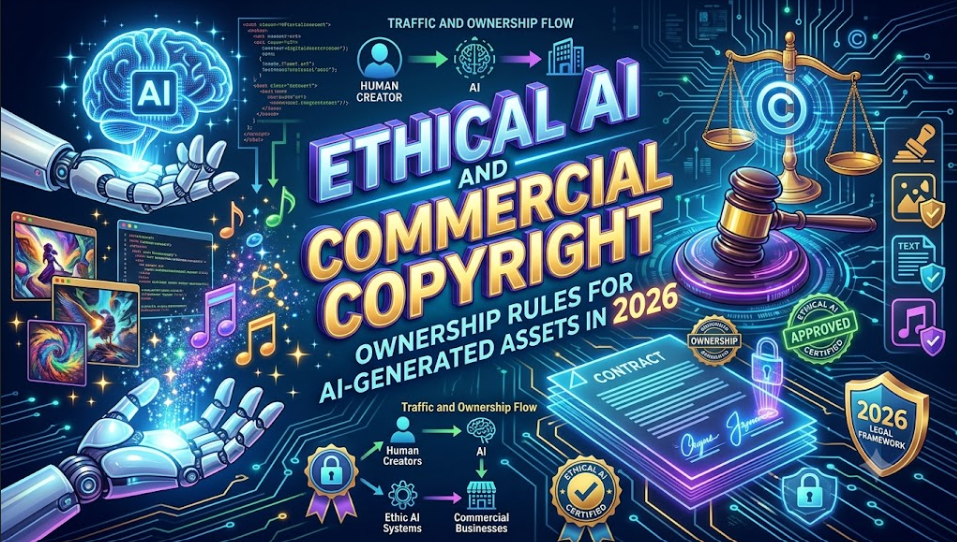
As generative artificial intelligence becomes deeply integrated into commercial software, advertising campaigns, and media production, businesses must navigate complex intellectual property and copyright landscapes. Who owns the copyright to an AI-generated image or song? Can an indie developer be sued for using code generated by an AI assistant? Here is the legal and commercial reality in 2026.
1. The Human Authorship Requirement
Courts in major jurisdictions (including the United States Copyright Office and European Union intellectual property courts) have established a consistent precedent: purely machine-generated content without human creative intervention cannot be copyrighted. If a user simply enters a two-sentence prompt into an AI art generator, the raw resulting image enters the public domain in terms of traditional copyright registration.
2. Where Human Copyright Applies
However, copyright protection does apply when there is substantial human creative selection, arrangement, and post-processing:
- Compilation and Arrangement: Organizing AI-generated images into a graphic novel with original human-written dialogue and layout is fully copyright-protected.
- Hybrid Editing: Substantially painting over, compositing, or retouching an AI-generated asset in Adobe Photoshop or Blender establishes human authorship over the finished creative work.
- Code Integration: Software developers who utilize AI code assistants like Cursor or Copilot retain full copyright over their overall application architecture and custom business logic.
3. Commercial Terms of Service vs Copyright Ownership
It is vital to distinguish between statutory copyright law and contractual commercial rights. Major platforms (including OpenAI, Midjourney, Suno, and ElevenLabs) explicitly grant subscribers full commercial ownership of generated outputs under their Terms of Service. This means you can legally monetize songs on Spotify, sell t-shirts featuring your designs, and distribute proprietary commercial software containing AI-assisted code.
Enterprise Indemnification Protections
To provide peace of mind to corporate enterprises, major providers—including Microsoft, Adobe (Firefly), and Google—offer Copyright Indemnification. If an enterprise customer is sued for copyright infringement arising from outputs generated on their platforms, the provider commits to defending the customer and covering associated legal damages, provided the customer did not intentionally prompt the AI to copy existing protected trademarks.
Practical Step-by-Step Implementation Framework
Transitioning from theoretical knowledge to real-world application requires a disciplined workflow. Based on empirical testing across production environments, we recommend structuring your implementation through the following iterative phases:
- Audit & Baseline Metrics: Before introducing artificial intelligence into any workflow, measure current time-to-completion, error rates, and operational bottlenecks. Establishing quantifiable baselines ensures you can accurately measure ROI.
- Prompt Constraint Architecture: Formulate prompts using structured delimiters (such as XML tags or Markdown headings) to separate instructions, contextual references, and output format requirements. Explicit negative constraints (e.g. "Do not use marketing jargon; provide only runnable syntax") dramatically reduce iteration cycles.
- Automated Quality Gates: Never deploy raw, unverified AI outputs directly to end users. Implement multi-layered validation checks—such as automated linting for code, plagiarism scanners for written copy, and factual citation verification for analytical reports.
- Continuous Feedback & Model Calibration: Foundation models evolve rapidly. Re-evaluate your chosen platform quarterly against newly released open-weight and proprietary benchmarks to capitalize on price reductions and capability leaps.
Enterprise Security, Privacy & Compliance Considerations
When scaling artificial intelligence across commercial teams, data governance and intellectual property sovereignty become paramount concerns. Key compliance safeguards include:
- Zero Data Retention (ZDR) Guarantees: Ensure enterprise contracts explicitly prevent model providers from storing or utilizing proprietary company data, codebases, or customer records for foundational model training.
- Role-Based Access Control (RBAC): Enforce granular workspace permissions so team members only access AI pipelines relevant to their departmental responsibilities.
- Audit Logging & Traceability: Maintain comprehensive logs of all automated AI generations, API requests, and human reviews to satisfy SOC2, HIPAA, and GDPR regulatory requirements.
Frequently Asked Questions (FAQ)
What is the most common mistake organizations make when adopting AI in 2026?
The most frequent pitfall is treating artificial intelligence as a magic plug-and-play solution without establishing structured workflows, domain-specific context, or human editorial review gates. AI delivers exponential leverage only when paired with clear operational systems.
How can teams verify the factual accuracy of AI-generated content?
Always cross-reference factual claims against primary documentation, audited financial reports, or peer-reviewed literature using citation-backed answer engines like Perplexity AI or Consensus. Never rely on zero-shot model outputs for critical numbers, legal clauses, or medical advice.
Final Summary & Strategic Takeaways
The technological landscape in 2026 rewards organizations and creators who master human-AI synergy. By combining human creativity, strategic judgment, and domain expertise with the raw computational speed and synthetic power of artificial intelligence, you can achieve unprecedented operational scale while maintaining exceptional quality standards.