

The Death of Frustrating Decision-Tree Chatbots
For more than a decade, online customer service chatbots were universally reviled. Users were subjected to rigid decision trees that looped endlessly, repeatedly asking irrelevant questions and failing to parse natural human language. If a customer had a complex issue involving order modifications, billing adjustments, or API authentication errors, the bot was utterly useless—serving only as a frustrating barrier between the customer and a human agent.
In 2026, the customer service landscape has undergone a total transformation. Foundation models equipped with retrieval-augmented generation (RAG), autonomous tool-calling capabilities, and deterministic safety filters have created true Autonomous Support Agents. Rather than regurgitating generic help center articles, modern support agents can verify user identities, check database records, issue refunds, adjust subscription tiers, and communicate in over eighty languages with empathy and nuance.
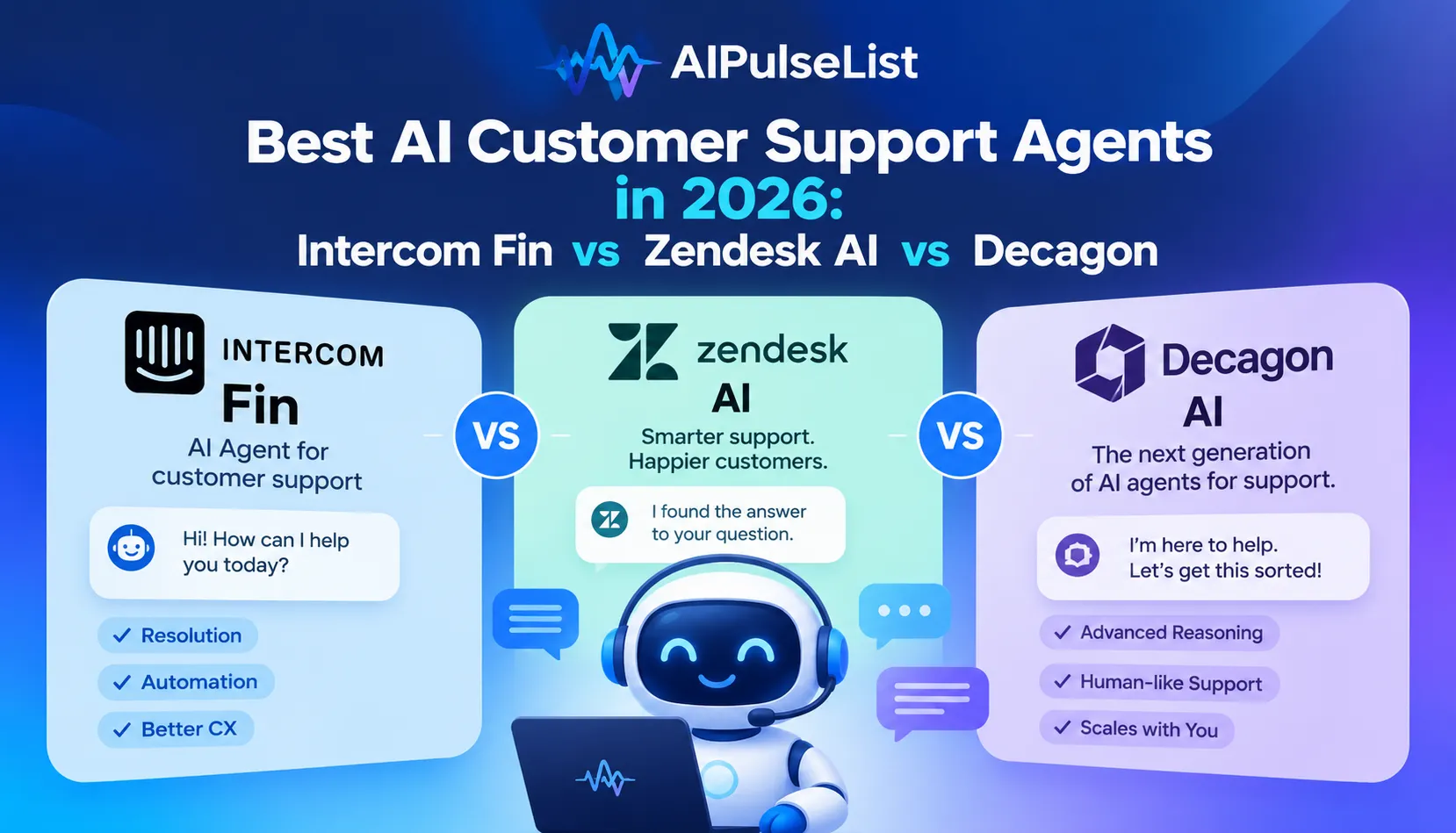
In this benchmark evaluation, our research team tested the three frontrunners in enterprise customer service intelligence—Intercom Fin 2.0, Zendesk Advanced AI, and Decagon—across real-world resolution velocity, hallucination rates, and cost efficiency.
💡 Pro-Tip for CX Leaders:
Explore all top-rated tools in our Customer Support & CRM AI Directory and compare user ratings and pricing tiers across 100+ vetted solutions.
The Core Metrics of Autonomous Customer Support
Before evaluating specific platforms, support engineering leaders must define the three critical key performance indicators (KPIs) that separate marketing hype from production value:
- Autonomous First-Contact Resolution (FCR): The percentage of inbound inquiries successfully resolved from end-to-end without requiring human escalation or agent triage.
- Zero-Hallucination Rate: The platform's ability to acknowledge when an answer is unknown and gracefully escalate, rather than fabricating inaccurate company policies or discounts.
- Bi-Directional Action Execution: The capacity to not just read knowledge base articles, but safely write changes back to billing systems, payment gateways, and shipping databases via secure API endpoints.
Contender 1: Intercom Fin 2.0 – The Conversational King
Intercom was an early mover in generative customer support, and Fin 2.0 represents the culmination of that head start. Built directly on top of Anthropic Claude and OpenAI foundation architectures, Fin operates with remarkable conversational fluency.
Key Strengths:
- Ingestion Velocity: Connects to Notion, Zendesk Help Center, GitHub discussions, and public URLs in under ten minutes without requiring manual vector database configuration.
- Customizable Guardrails: Administrators can explicitly instruct Fin to avoid certain topics, restrict answers exclusively to verified internal URLs, and trigger mandatory human escalation for VIP accounts.
- Transparent Resolution Pricing: Intercom charges $0.99 per successful resolution. If the customer is unsatisfied or escalates to a human teammate, you pay zero dollars for that interaction.
Areas for Improvement: While exceptional for conversational SaaS troubleshooting, setting up multi-system transaction workflows (e.g., verifying a warehouse packing slip and updating an ERP) requires configuring complex custom webhooks in Intercom Apps.
Contender 2: Zendesk Advanced AI – Enterprise Powerhouse
Zendesk powers customer support for tens of thousands of global corporations. Rather than discarding their legacy ticketing system, Zendesk built advanced machine learning models directly into their existing enterprise workflow engine.
Key Strengths:
- Intent & Sentiment Triage: Automatically tags incoming tickets with customer sentiment (e.g., "Angry," "Urgent," "Cancellation Risk") before a human agent even opens the inbox.
- Agent Copilot Assistance: For tickets handled by human agents, Zendesk AI summarizes multi-page customer histories into three bullet points and suggests one-click macro responses.
- Omnichannel Breadth: Flawlessly integrates voice call transcriptions, WhatsApp messages, SMS notifications, and traditional email tickets into a unified timeline.
Areas for Improvement: Full deployment can be cumbersome and typically requires dedicated professional services. Pricing tiers can also quickly escalate for large teams with enterprise seat requirements.
Contender 3: Decagon – The Autonomous Engine for Complex Workflows
Decagon has emerged as the breakout enterprise challenger, favored by tech-forward leaders like Substack, Eventbrite, and Bilt Rewards. While competitors focus on answering FAQs, Decagon was engineered from scratch as an action-executing agent.
Key Strengths:
- Multi-Step Business Logic: Decagon can natively execute complex logic: checking an airline flight delay status, verifying baggage tracking APIs, and initiating an automated compensation voucher in Stripe.
- Autonomous Voice & Chat: Operates seamlessly across web chat, mobile SDKs, and phone systems with human-grade audio latency under 450 milliseconds.
- Active Learning Loops: Surfaces clustering reports identifying exactly which product bugs or confusing policies are driving inbound ticket volume, helping product managers fix root causes.
Direct Benchmark Comparison Table
| Metric / Feature | Intercom Fin 2.0 | Zendesk Advanced AI | Decagon |
|---|---|---|---|
| Avg. First-Contact Resolution | 54% – 68% | 45% – 60% | 65% – 78% |
| Setup Time to Launch | 1 – 2 Days | 2 – 4 Weeks | 1 – 2 Weeks |
| Voice Phone Support | Third-party app only | Integrated Voice IVR | Native Real-time AI Voice |
| API / Webhook Tool Calling | Intermediate | Advanced (Via Marketplace) | Native Autonomous Actions |
| Pricing Model | $0.99 / resolution + base | $55 – $115 / agent seat / mo | Custom Enterprise Contract |
Architecting Dynamic Escalation SLAs & Human Handoffs
The single greatest operational hazard in AI customer support is stranding a frustrated customer in an endless machine loop. High-performing CX organizations design rigorous algorithmic escalation triggers that instantly route conversations to senior tier-2 specialists:
- Negative Sentiment Acceleration: If the model detects high-frequency frustration markers (e.g., words like "lawyer," "chargeback," "unacceptable," or aggressive capitalization), the bot halts autonomous execution and transfers the chat within 15 seconds.
- Financial & Legal Thresholds: Any inquiry concerning refund requests exceeding $500, claims of property damage, or formal regulatory inquiries are automatically flagged as non-automatable.
- Zero-Friction Context Preservation: When an escalation occurs, the customer is never asked to re-explain their problem. The AI generates a 3-bullet handover brief that is pinned to the human agent's screen before they even type their first greeting.
Safety Architecture: Preventing Customer Service Catastrophes
Deploying autonomous agents to speak directly with customers carries real operational risk. In previous years, poorly safeguarded bots were tricked by playful users into agreeing to sell cars for one dollar or apologizing for crimes the company never committed. In 2026, enterprise platforms enforce multi-layer defense mechanisms:
- RAG Source Pinning: The agent cannot answer questions using open-web knowledge. It can only synthesize sentences directly backed by citation IDs in your verified documentation.
- Deterministic Action Confirmation: Financial actions (issuing refunds, resetting enterprise passwords) require dual confirmation: the customer receives a one-time SMS or email passcode before the agent calls the payment gateway.
- Automated Red-Teaming: Platforms run thousands of synthetic prompt-injection attacks against your knowledge base nightly to identify security vulnerabilities before malicious users find them.
Implementation Checklist for 2026
Ready to upgrade your customer experience? Use this prioritized implementation framework:
- Audit your top 20 most frequent support reasons in your ticketing history.
- Ensure help center articles for those 20 issues are completely accurate, concise, and formatted with clear step-by-step instructions.
- Deploy your chosen AI agent in "Shadow Mode" for 7 days, allowing it to generate draft responses for human agent review without sending messages to customers.
- Evaluate shadow accuracy and calibrate tone guardrails.
- Flip the switch to autonomous resolution on simple tier-1 inquiries (order status, password reset, business hours).
- Gradually expand permissions to transactional workflows as confidence metrics hit 99% accuracy.
Conclusion
Autonomous AI support agents do not replace human empathy; they protect it. By autonomously resolving 60% or more of repetitive, mundane tier-1 inquiries in seconds, your human support team is liberated to handle sensitive escalations, high-value account relationships, and complex customer challenges with the patience and dedication they deserve.