

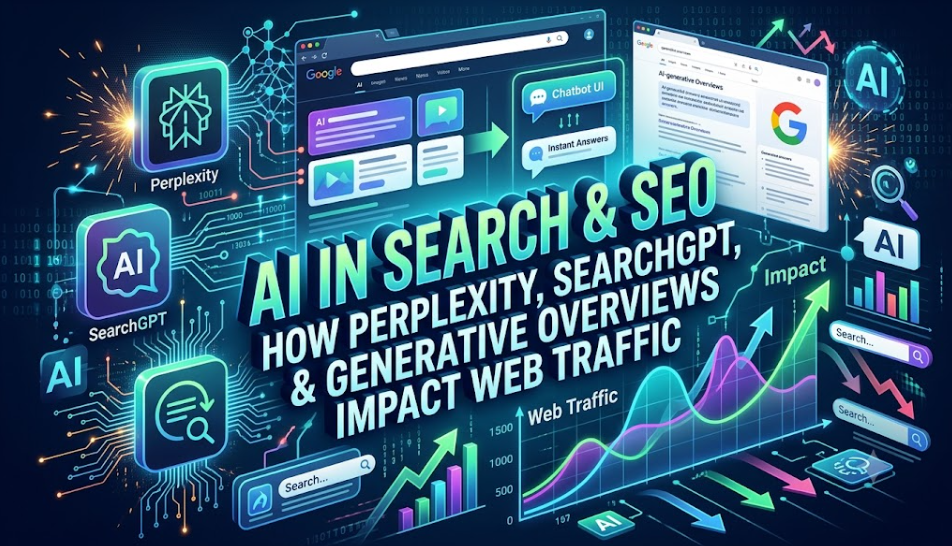
For over two decades, the contract between web publishers and search engines was straightforward: content creators published informative articles, search engines indexed the pages, and users clicked through blue links to visit the publisher’s website. In 2026, the rise of conversational answer engines—including Perplexity AI, SearchGPT, and Google AI Overviews—is transforming organic discovery into a new discipline known as Generative Engine Optimization (GEO).
1. The Zero-Click Search Reality
For simple factual queries (such as currency conversions, dates, or brief definitions), generative answer engines synthesize the answer directly on the search page, eliminating the need for the user to visit an external website. As a result, informational content websites relying on shallow, generic definitions have experienced sharp traffic declines.
2. The Rise of Generative Engine Optimization (GEO)
To thrive in this new landscape, digital publishers and businesses must optimize not just for traditional search ranking algorithms, but for inclusion within AI syntheses:
- Primary Source Data & Original Testing: AI search models heavily favor unique first-party data, proprietary surveys, and original hands-on testing that cannot be synthesized from existing web pages.
- Quotable Structured Statements: Writing concise, authoritative 2-sentence summary takeaways that AI crawlers can easily extract as inline citations.
- Schema.org Structured Data: Implementing comprehensive JSON-LD schemas (such as FAQPage, SoftwareApplication, and Author profiles) ensures AI scrapers comprehend page hierarchy with 100% precision.
3. Brand Mention Authority and Knowledge Graphs
Generative models like Perplexity rely on cross-referencing multiple authoritative web domains. If your product or tool is consistently cited across Reddit discussions, tech review directories, Wikipedia, and verified industry publications, the AI will consistently recommend your brand as a top answer.
Conclusion
The death of search has been greatly exaggerated. While generic "thin content" is being weeded out, high-authority editorial directories and in-depth analytical publications are capturing higher-converting, intent-driven traffic than ever before.
Practical Step-by-Step Implementation Framework
Transitioning from theoretical knowledge to real-world application requires a disciplined workflow. Based on empirical testing across production environments, we recommend structuring your implementation through the following iterative phases:
- Audit & Baseline Metrics: Before introducing artificial intelligence into any workflow, measure current time-to-completion, error rates, and operational bottlenecks. Establishing quantifiable baselines ensures you can accurately measure ROI.
- Prompt Constraint Architecture: Formulate prompts using structured delimiters (such as XML tags or Markdown headings) to separate instructions, contextual references, and output format requirements. Explicit negative constraints (e.g. "Do not use marketing jargon; provide only runnable syntax") dramatically reduce iteration cycles.
- Automated Quality Gates: Never deploy raw, unverified AI outputs directly to end users. Implement multi-layered validation checks—such as automated linting for code, plagiarism scanners for written copy, and factual citation verification for analytical reports.
- Continuous Feedback & Model Calibration: Foundation models evolve rapidly. Re-evaluate your chosen platform quarterly against newly released open-weight and proprietary benchmarks to capitalize on price reductions and capability leaps.
Enterprise Security, Privacy & Compliance Considerations
When scaling artificial intelligence across commercial teams, data governance and intellectual property sovereignty become paramount concerns. Key compliance safeguards include:
- Zero Data Retention (ZDR) Guarantees: Ensure enterprise contracts explicitly prevent model providers from storing or utilizing proprietary company data, codebases, or customer records for foundational model training.
- Role-Based Access Control (RBAC): Enforce granular workspace permissions so team members only access AI pipelines relevant to their departmental responsibilities.
- Audit Logging & Traceability: Maintain comprehensive logs of all automated AI generations, API requests, and human reviews to satisfy SOC2, HIPAA, and GDPR regulatory requirements.
Frequently Asked Questions (FAQ)
What is the most common mistake organizations make when adopting AI in 2026?
The most frequent pitfall is treating artificial intelligence as a magic plug-and-play solution without establishing structured workflows, domain-specific context, or human editorial review gates. AI delivers exponential leverage only when paired with clear operational systems.
How can teams verify the factual accuracy of AI-generated content?
Always cross-reference factual claims against primary documentation, audited financial reports, or peer-reviewed literature using citation-backed answer engines like Perplexity AI or Consensus. Never rely on zero-shot model outputs for critical numbers, legal clauses, or medical advice.
Final Summary & Strategic Takeaways
The technological landscape in 2026 rewards organizations and creators who master human-AI synergy. By combining human creativity, strategic judgment, and domain expertise with the raw computational speed and synthetic power of artificial intelligence, you can achieve unprecedented operational scale while maintaining exceptional quality standards.