

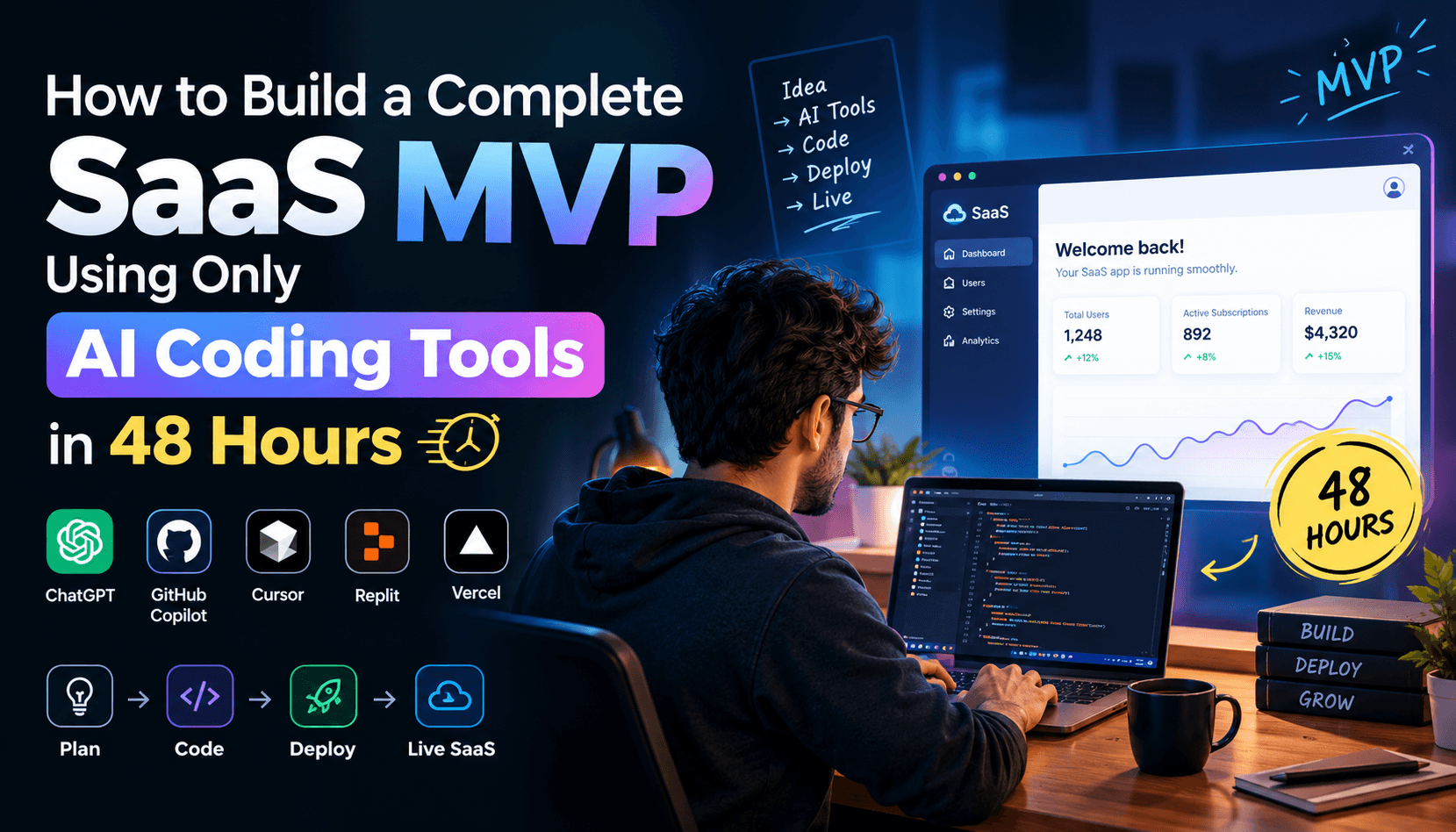
The Era of the One-Person Software Unicorn
Just five years ago, launching a functional Software-as-a-Service (SaaS) Minimum Viable Product required an entire engineering team, months of grueling sprint planning, thousands of dollars in server infrastructure, and dozens of sleepless nights. Today, that barrier to entry has completely crumbled.
In 2026, solo founders and bootstrapped developers are routinely building, launching, and monetizing production-ready SaaS applications in a single weekend. By leveraging generative UI builders, autonomous coding co-pilots, serverless databases, and automated payment gateways, an individual developer can achieve 10x the output of a traditional engineering squad.
This article provides a battle-tested, 48-hour blueprint for transforming an initial product idea into a deployed, paying-customer-ready SaaS product between Friday evening and Sunday night.
The Recommended 2026 AI SaaS Tech Stack
To move with maximum velocity, you must select modern tools with strong AI interoperability and zero infrastructure boilerplate:
- Frontend & Framework: Next.js 15 (App Router) or Vite + Vanilla CSS/Tailwind for instant responsiveness.
- Generative UI: v0.dev for converting text prompts into production-grade React components.
- AI Coding Environment: Cursor AI or Windsurf paired with Claude 3.5 Sonnet / Claude 3.7 Sonnet.
- Database & Authentication: Supabase (PostgreSQL with Row-Level Security) or SQLite + LiteFS.
- Payment Processing: Stripe Checkout or Lemon Squeezy for global tax and subscription management.
- Hosting & Edge Deployment: Vercel, Cloudflare Pages, or cPanel for frictionless continuous deployment.
🚀 Founder Resource:
Building an entrepreneurial venture? Discover our curated toolkits for Startup Founders & Entrepreneurs and explore verified SaaS Discounts & Deals.
The 48-Hour Execution Roadmap
Hours 0–6 (Friday Evening): Concept Validation & Generative UI Prototyping
Never write code before you have clarity of scope. Start by defining your Product Requirements Document (PRD) using Claude. Be ruthlessly disciplined about features: cut everything except the one single capability that solves your user's primary pain point.
Next, use v0.dev to generate your application's primary screens:
- A high-converting landing page with social proof, pricing tiers, and a sticky CTA.
- The main authenticated user dashboard where the core action occurs.
- An account settings modal containing billing and subscription cancellation options.
Export the clean React/HTML primitives directly into your newly initialized GitHub repository.
Hours 6–18 (Saturday Morning): Database Architecture & Authentication
With your UI in place, connect your persistence layer. Using Supabase, prompt Cursor AI to draft your database migrations:
-- Create User Profiles with Subscription Tiers CREATE TABLE profiles ( id UUID REFERENCES auth.users ON DELETE CASCADE PRIMARY KEY, email TEXT NOT NULL, subscription_tier TEXT DEFAULT 'free', -- 'free', 'pro', 'enterprise' stripe_customer_id TEXT, created_at TIMESTAMP WITH TIME ZONE DEFAULT timezone('utc'::text, now()) NOT NULL ); -- Enable strict Row Level Security (RLS) ALTER TABLE profiles ENABLE ROW LEVEL SECURITY; CREATE POLICY "Users can only read their own profile" ON profiles FOR SELECT USING (auth.uid() = id);
Enable Supabase Email OTP or Google OAuth so users can sign up with a single click without managing passwords.
Hours 18–30 (Saturday Afternoon & Evening): The Core Value Engine
This is where your unique product logic lives. Whether your SaaS analyzes PDFs, generates marketing copy, or benchmarks social media metrics, keep the core API route clean and modular. Use AI co-pilots in Cursor with Composer mode (Ctrl + I) to generate end-to-end API routes with rigorous request validation and rate limiting.
Hours 30–40 (Sunday Morning): Monetization & Webhook Synchronization
A project is not a SaaS until it can charge money. Set up a Stripe Customer Portal and Checkout Session:
- Create two products in your Stripe Dashboard: Pro Monthly ($19/mo) and Pro Annual ($190/yr).
- Build a secure Stripe webhook listener (/api/webhooks/stripe) to process checkout.session.completed, customer.subscription.updated, and invoice.payment_failed events.
- Ensure that your database updates the user's subscription_tier column immediately upon receiving a signed Stripe signature.
// Sample Next.js Stripe Webhook Route Handler import { stripe } from '@/lib/stripe'; import { supabaseAdmin } from '@/lib/supabaseAdmin'; export async function POST(req: Request) { const body = await req.text(); const signature = req.headers.get('stripe-signature')!; let event; try { event = stripe.webhooks.constructEvent(body, signature, process.env.STRIPE_WEBHOOK_SECRET!); } catch (err: any) { return new Response(`Webhook Error: ${err.message}`, { status: 400 }); } if (event.type === 'checkout.session.completed') { const session = event.data.object as any; const userId = session.metadata.userId; await supabaseAdmin .from('profiles') .update({ subscription_tier: 'pro', stripe_customer_id: session.customer }) .eq('id', userId); } return new Response(JSON.stringify({ received: true }), { status: 200 }); }
Hours 40–48 (Sunday Afternoon): Security Auditing, SEO & Deployment
Before launching to the public, execute an autonomous security audit. Instruct your AI co-pilot to scan every server route for authorization bypasses, SQL injection vulnerabilities, and exposed API credentials.
Configure automated SEO meta tags, OpenGraph preview cards, and deploy your build with one push to your production domain on Vercel or Cloudflare.
The 10-Point Pre-Launch Sanity Checklist
Before sharing your link on social media on Sunday evening, verify every item on this checklist:
- Test Real Card Transactions: Use Stripe Test Mode to verify that upgrading unlocks pro features immediately and that card declines trigger user-friendly error banners.
- Confirm Mobile Layouts: Test your landing page on actual iPhone and Android screens to ensure CTAs are within thumb reach.
- Validate OpenGraph Tags: Use Twitter Card Validator and OpenGraph.xyz to verify that social link shares show attractive custom preview banners.
- Check Rate Limiting: Protect expensive AI endpoints using Upstash Redis so malicious scrapers cannot burn through your API balance.
- Implement Sentry Error Logging: Capture unhandled React or API exceptions silently in real time.
48-Hour SaaS Milestone Breakdown
| Timeframe | Core Focus | Key AI Tools Used | Deliverable Milestone |
|---|---|---|---|
| Fri 6 PM – 12 AM | PRD & Generative UI | v0.dev, Claude 3.5 Sonnet | Working frontend components |
| Sat 8 AM – 2 PM | Database & Auth | Cursor AI, Supabase RLS | Working auth & secure schema |
| Sat 2 PM – 10 PM | Core Product Logic | Cursor Composer, OpenAI API | Functional value delivery |
| Sun 8 AM – 2 PM | Payments & Webhooks | Stripe CLI, Cursor AI | Live recurring checkout |
| Sun 2 PM – 6 PM | Security & Live Launch | Vercel, Cloudflare, Sentry | 🚀 Deployed to first users |
Frequently Asked Questions (FAQ)
Can non-programmers build a SaaS using this 48-hour method?
While AI tools dramatically lower technical barriers, understanding core programming concepts (APIs, HTTP status codes, relational database relations, and Git) is crucial for resolving edge cases and keeping user data safe.
How much does it cost to build and host an MVP this way?
Virtually nothing. The entire stack can be assembled using free tiers: Supabase free tier (500MB database), Vercel free tier (100GB bandwidth), v0.dev free tier, and Stripe (pay-as-you-earn transaction percentage). Your only mandatory expense is a domain name ($10–$15).
What is the biggest trap that derails weekend SaaS builds?
Feature creep. Builders often get caught up attempting to add team workspaces, multi-tenancy, dark/light theme pickers, and social feeds before verifying if anyone wants their core product. Strip every feature down to the single most vital interaction.
Where should I launch on Sunday night to get initial users?
Post authentic build-in-public breakdowns on Twitter/X, share practical demos on relevant Reddit communities (such as r/SideProject and r/SaaS), submit to Product Hunt, and list your tool in curated directories like AI Pulse to earn initial high-authority dofollow backlinks.
Conclusion
The playing field of software entrepreneurship has been permanently democratized. If you have a clear idea and two days of focused execution, modern artificial intelligence tools give you the superpowers to ship a real, functioning business before Monday morning arrives.