

The Expiration of "Prompt Voodoo"
Between 2022 and 2024, the tech world became infatuated with "prompt engineering" as an esoteric art. Social media feeds were inundated with self-styled prompt gurus selling PDF cheatsheets containing magic phrases like: "Act as an expert astrophysicist with twenty years of tenure," or "Take a deep breath and think step by step," or "I will tip you $200 for a perfect answer."
While those rhetorical tricks provided marginal accuracy bumps on early language models, treating production software development as a superstitious trial-and-error ritual was always unsustainable. In high-stakes enterprise applications, changing an underlying foundation model version would instantly break brittle prompts, causing production pipelines to collapse into unformatted prose, failed API calls, and non-deterministic errors.
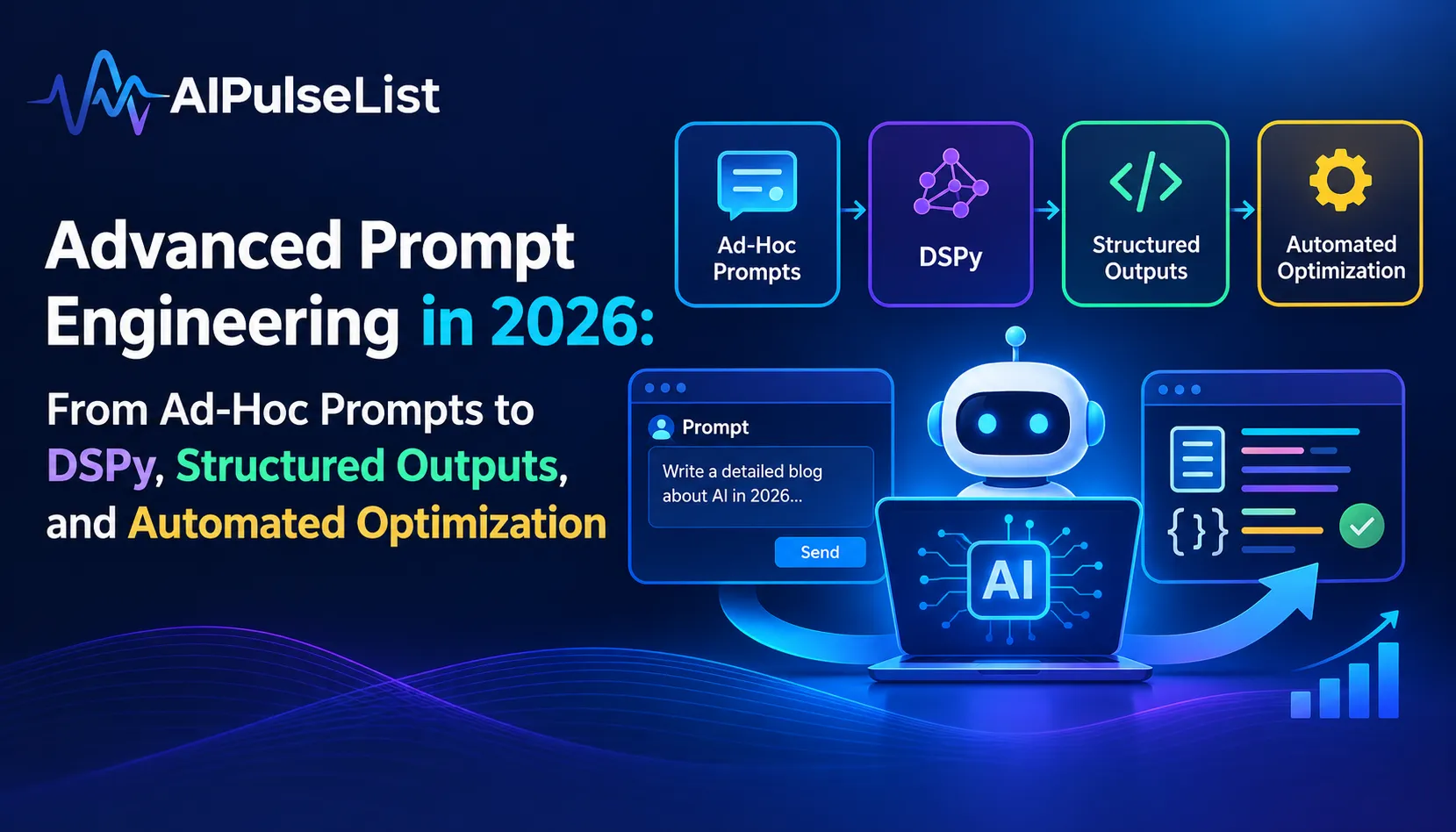
In 2026, prompt engineering has matured from fragile black magic into a rigorous, programmatic software engineering discipline. Modern developers do not manually guess strings; they compile prompts algorithmically, enforce strict deterministic JSON schemas at the inference engine level, and deploy automated optimization frameworks like DSPy that continuously calibrate prompts against quantitative unit test suites.
💡 Pro-Tip for Software Engineers:
Check our specialized Prompt Engineering & LLM Tooling Directory for automated prompt optimizers, evaluation frameworks, and testing harnesses.
1. The Rise of Compile-Time Prompting: Stanford DSPy
Developed by researchers at Stanford University, DSPy (Declarative Self-improving Python) represents the most significant breakthrough in LLM application architecture over the past three years. DSPy completely decouples the *intent* of your pipeline from the brittle phrasing of specific strings.
Instead of manually writing a 500-word prompt, in DSPy you define three modular programming constructs:
- Signatures: Declarative specifications of your inputs and outputs (e.g., question -> answered_sql_query).
- Modules: Reusable algorithmic building blocks (such as dspy.ChainOfThought, dspy.ReAct, or dspy.MultiHop).
- Teleprompters / Optimizers: Compilers that inspect your pipeline, run it against a training dataset of 50 to 100 labeled examples, evaluate performance using custom validation metrics, and autonomously write, refine, and select the optimal prompt strings and few-shot examples.
The practical result? When Anthropic releases a new Claude model or OpenAI updates its reasoning endpoints, you do not rewrite your prompts manually. You simply re-run your DSPy compiler, and it synthesizes the ideal prompt configuration tailored specifically to the mathematical idiosyncrasies of that new model.
Code Walkthrough: Compiling a Production Pipeline with DSPy
To understand the sheer power of compile-time prompt optimization over manual string authoring, review this concise Python implementation demonstrating a self-optimizing SQL extraction pipeline:
import dspy # 1. Define the Declarative Signature class NaturalLanguageToSQL(dspy.Signature): """Translate natural language business questions into optimized, safe SQL queries.""" schema_context = dspy.InputField(desc="The relational database schema tables and columns") user_question = dspy.InputField(desc="The user's analytical question in plain English") sql_query = dspy.OutputField(desc="Syntactically valid MySQL query with zero markdown formatting") # 2. Build the Modular Pipeline class TextToSQLPipeline(dspy.Module): def __init__(self): super().__init__() self.generate_sql = dspy.ChainOfThought(NaturalLanguageToSQL) def forward(self, schema_context, user_question): return self.generate_sql(schema_context=schema_context, user_question=user_question) # 3. Compile & Optimize with BootstrapFewShot teleprompter optimizer = dspy.BootstrapFewShot(metric=sql_execution_validation_metric) compiled_pipeline = optimizer.compile(TextToSQLPipeline(), trainset=labeled_gold_queries)
Notice what is missing from this code: there is not a single hardcoded prompt string. The DSPy compiler tests hundreds of candidate prompts, evaluates query execution accuracy against a live database sandbox, and outputs the mathematical optimum with zero human guesswork.
2. Guaranteed Structured Outputs & Constrained Decoding
For years, backend developers lived in constant terror of runtime JSON parsing errors. An LLM would output 99% valid JSON, but occasionally precede the output with "Here is your JSON response:" or leave an unclosed quotation mark at the end of a long array, instantly crashing production database ingestion scripts.
In 2026, Constrained Decoding and native Structured Outputs have permanently eliminated this category of bugs. Rather than relying on the model to "try its best" to generate valid syntax, modern inference engines (such as Outlines, Guidance, and native OpenAI/Anthropic JSON schema endpoints) operate at the token logit level:
- Before emitting each token, the inference engine evaluates the formal context-free grammar (CFG) or Pydantic schema.
- Any token that would mathematically violate the required JSON syntax is assigned a probability of zero and masked out before sampling.
- The resulting payload is 100% mathematically guaranteed to parse flawlessly into typed Pydantic models or TypeScript interfaces on the first attempt, with zero formatting errors.
3. Test-Time Compute & Reasoning Control (o3-mini, Claude Thinking)
The latest generation of frontier reasoning architectures (such as OpenAI o3-mini and Claude 3.7 Sonnet) incorporate dynamic thinking budgets. Prompt engineering for these reasoning models requires an entirely different philosophy:
- Eliminate Redundant "Think Step-by-Step" Boilerplate: Reasoning models already execute extensive test-time compute chains natively. Adding repetitive instructions like "Explain your logic thoroughly before answering" often wastes tokens and degrades reasoning depth.
- Focus on Problem Formulation & Verification Checks: Dedicate prompt real estate to providing unambiguous boundary constraints, edge cases, negative examples, and deterministic acceptance tests.
- Calibrate Thinking Budgets: Modern APIs allow developers to dynamically scale reasoning tokens (e.g., allocating 1,000 thinking tokens for simple customer address lookups vs. 16,000 thinking tokens for multi-file legacy code refactoring).
Evolution of Prompt Engineering Paradigms (2023 vs 2026)
| Dimension | Early Era (2022 – 2024) | Modern Era (2026) |
|---|---|---|
| Prompt Authoring | Manual string tweaking in chat playgrounds | Automated compilation via DSPy & GEval |
| Output Formatting | Begging the model: "Return ONLY valid JSON" | Deterministic Logit Masking & Pydantic Schemas |
| Evaluation Strategy | Subjective "Vibes" and eyeball testing | Automated CI/CD regressions on 500+ unit test cases |
| Model Portability | Brittle; model changes broke applications | Model-agnostic declarative signatures |
| Cost Optimization | Random manual prompt truncation | Prompt caching, token distillation & routing |
Prompt Drift Detection & CI/CD Regression Testing
Even when prompts are compiled, model providers frequently update inference checkpoints without changing version numbers, occasionally causing subtle semantic shifts in production outputs. Forward-thinking engineering organizations treat prompts like critical software code by introducing automated prompt eval regression tests into their continuous integration (CI/CD) pipelines:
- Golden Dataset Gatekeepers: A test suite containing 200 diverse edge cases runs automatically on every Git pull request. If model accuracy, latency, or token consumption regresses by more than 2%, the build is blocked.
- LLM-as-a-Judge Consistency Scoring: High-reasoning models evaluate production output quality against factual ground-truth benchmarks, outputting quantitative G-Eval alignment scores.
- Synthetic Edge-Case Ingestion: Continuous fuzzing with adversarial inputs ensures prompt injection attacks cannot force system prompts to reveal confidential instructions or database credentials.
Essential Architectural Blueprint for Production LLM Pipelines
If you are architecting a mission-critical AI feature today, adhere to this four-layer software stack:
- Layer 1: Type-Safe Schema Definition: Use Pydantic or Zod to declare strict data structures for every model input and output. Reject any ad-hoc string returns.
- Layer 2: Prompt Caching Architecture: Take advantage of prompt caching on models like Claude and Gemini. Place invariant system instructions, API documentation, and static few-shot examples at the beginning of your prompt payload so they are cached in GPU memory, cutting latency by 80% and token costs by up to 90%.
- Layer 3: Evaluation Suite (Evals): Construct an evaluation harness with at least 100 representative edge cases. Every time a prompt is edited or an optimizer is run, automatically calculate precision, recall, and token efficiency scores.
- Layer 4: Fallback & Router Model Chains: Route simple classification tasks to ultra-fast, low-cost models (like GPT-4o-mini or Haiku 3.5), only invoking expensive high-reasoning models when prompt complexity triggers explicit difficulty heuristics.
Conclusion: The Engineer Takes Over from the Shaman
The era of treating language models like unpredictable mystical oracles is officially over. By replacing manual prompt guessing with declarative code, programmatic compilers, and deterministic output grammars, software engineers can finally build AI applications that satisfy the uncompromising reliability, predictability, and performance standards of modern enterprise software.