

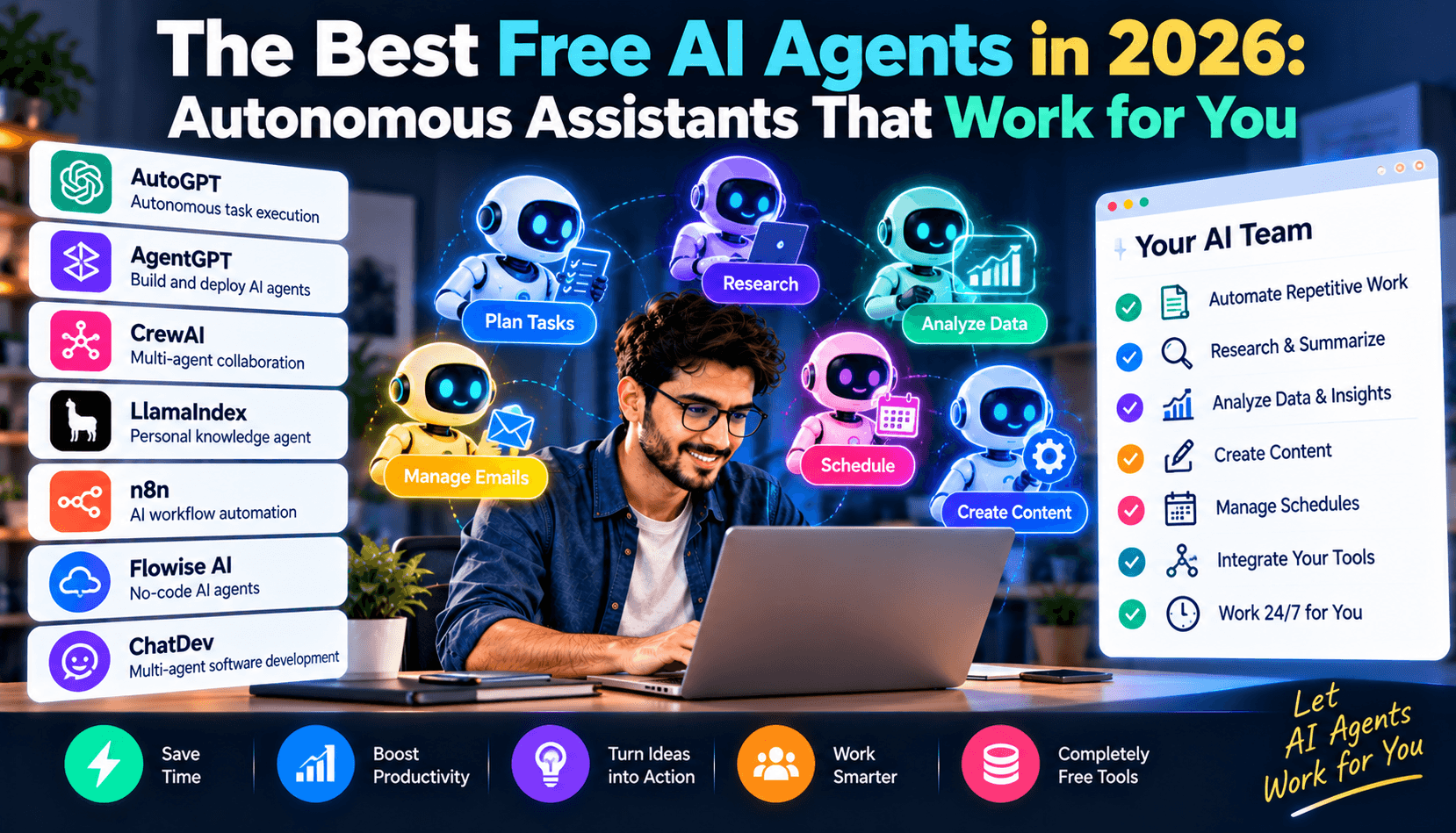
The Paradigm Shift: From Passive Chatbots to Action-Oriented Agents
In 2026, the artificial intelligence landscape experienced its most monumental paradigm shift since the initial release of generative language models. For years, users were accustomed to passive chatbots: you typed a prompt, waited a few seconds, and received a static text response. If you wanted to turn that text into reality—such as writing code, creating database records, sending emails, or scraping market research—you still had to do the heavy lifting yourself.
Today, that boundary has dissolved with the rise of autonomous AI agents. Instead of merely answering questions, an AI agent is designed to achieve a high-level goal by executing an iterative loop: observing the environment, formulating a multi-step plan, calling external tools (such as web browsers, terminal shells, APIs, and calculators), reviewing the intermediate results, and self-correcting until the objective is accomplished.
While proprietary enterprise platforms charge hundreds of dollars per user every month, a flourishing open-source and free-tier ecosystem has emerged. In this comprehensive guide, we test and rank the best free autonomous AI agents available in 2026, complete with installation steps, benchmark comparisons, and practical safety protocols.
How Autonomous AI Agents Actually Work
To understand why autonomous agents are so revolutionary, it helps to understand their underlying cognitive loop, commonly referred to as the OODA loop (Observe, Orient, Decide, Act):
- Observation: The agent inspects its environment, reading input files, DOM trees on a web page, or API responses.
- Planning & Decomposition: Rather than jumping directly into the answer, the agent breaks the user's high-level request into a Directed Acyclic Graph (DAG) of logical milestones.
- Tool Invocation: The agent chooses from an arsenal of integrated capabilities—such as running a Python script, executing a SQL query, or clicking a button on a web browser.
- Reflection & Self-Correction: If a tool returns an error (for example, a 404 page or a syntax error in generated code), the agent inspects the stack trace and adjusts its plan without human intervention.
💡 Pro-Tip for Directory Users:
Looking for zero-cost solutions across other disciplines? Check out our verified collection of 100% Free AI Software Tiers and curated toolkits for Software Engineers.
Top 5 Free & Open-Source AI Agents Reviewed
1. CrewAI: The Leader in Multi-Agent Collaboration
CrewAI has rapidly cemented itself as the gold standard for orchestrating teams of collaborative autonomous agents. Rather than trying to force a single model to act as a jack-of-all-trades, CrewAI allows you to define specialized roles, complete with distinct personas, goals, and tooling access:
- The Senior Market Researcher: Navigates live news feeds, extracts company filings, and summarizes raw figures.
- The Editorial Strategist: Evaluates research findings and structures persuasive executive briefs.
- The Compliance Auditor: Cross-checks every assertion against authoritative citations to eliminate synthetic hallucinations.
CrewAI runs seamlessly on top of free local models using Ollama or inexpensive API endpoints, making it both accessible and enterprise-scalable.
2. AutoGPT: The Autonomous Open-Source Pioneer
As the project that sparked the autonomous agent revolution, AutoGPT in 2026 has evolved into a robust modular platform. Featuring a modern visual builder and an extensive plugin ecosystem, AutoGPT can browse the web, store long-term vector memories in local SQLite databases, and execute multi-day research tasks autonomously.
3. Browser-Use: Next-Generation Visual Web Automation
Traditional scrapers break whenever a website updates its HTML markup. Browser-Use bypasses this issue entirely by connecting vision-language models directly to headless Chromium. The agent looks at screenshots of web pages, understands layout elements visually, clicks buttons, solves form steps, and handles authentication without fragile CSS selectors.
4. Camel AI: Communicative Agents for Autonomous Roleplay
Camel AI pioneers communicative agent exploration, where two or more autonomous agents engage in cooperative multi-turn problem solving. By setting up an "Inception Prompt," an agent acting as an instructor and an agent acting as an assistant iterate toward complex software architecture blueprints without human prompting.
5. OpenDevin (All-Hands AI): Autonomous Software Engineering
For programmers, OpenDevin delivers an autonomous software developer operating within a secure Docker container. It can clone GitHub repositories, identify failing unit tests, edit multiple code files simultaneously, run build pipelines, and open clean pull requests automatically.
Feature & Benchmark Comparison Matrix
Below is a comparative breakdown of the top free and open-source autonomous agent frameworks evaluated in our benchmark testing:
| Agent Platform | Primary Use Case | Local LLM Support | Tool Ecosystem | Setup Complexity | Overall Rating |
|---|---|---|---|---|---|
| CrewAI | Multi-agent role-playing & team workflows | Yes (Ollama / vLLM) | Extensive (Search, Scrape, DB) | Beginner-Friendly | ★ 4.9 / 5.0 |
| Browser-Use | Vision-driven web navigation & scraping | Yes (Vision models) | Playwright / Chrome | Moderate | ★ 4.8 / 5.0 |
| OpenDevin | Autonomous full-stack software development | Yes (Code models) | Docker / Bash / Git | Advanced | ★ 4.7 / 5.0 |
| AutoGPT | General-purpose goal-oriented tasks | Yes (LangChain / Llama) | Marketplace Plugins | Moderate | ★ 4.6 / 5.0 |
| Camel AI | Cooperative dialog & simulation research | Yes (HuggingFace) | Custom Python Callables | Advanced | ★ 4.5 / 5.0 |
Step-by-Step Tutorial: Running Your First Local Multi-Agent Team
To illustrate how accessible autonomous agents have become, here is a complete Python implementation using CrewAI and a locally hosted Ollama model. In less than 30 lines of code, you can build an automated competitive intelligence team:
from crewai import Agent, Task, Crew, Process from langchain_community.llms import Ollama # 1. Connect to free local model (zero API fees) local_llm = Ollama(model="llama3.3") # 2. Define specialized autonomous agents researcher = Agent( role="Tech Market Scout", goal="Identify the 3 most promising AI developer tools launched this week", backstory="You are an expert Silicon Valley tech analyst who verifies metrics rigorously.", verbose=True, llm=local_llm ) writer = Agent( role="Executive Technology Editor", goal="Synthesize research findings into a 200-word punchy newsletter briefing", backstory="You write concise, high-impact technology summaries for busy CTOs.", verbose=True, llm=local_llm ) # 3. Create discrete tasks task1 = Task(description="Find 3 breakout AI developer tools with pricing details.", agent=researcher) task2 = Task(description="Draft an executive newsletter briefing based on task1 output.", agent=writer) # 4. Execute the multi-agent workflow tech_crew = Crew( agents=[researcher, writer], tasks=[task1, task2], process=Process.sequential ) result = tech_crew.kickoff() print("Final Synthesis:\n", result)
Critical Safety Protocols & Guardrails
Autonomous agents possess the ability to run arbitrary code, write files, and interact with the live internet. When deploying them, adhering to strict safety protocols is mandatory:
- Mandatory Docker Sandboxing: Never grant an autonomous agent root access to your host operating system. Execute all coding agents inside disposable Docker containers with restricted network privileges.
- Hard API Spending Caps: If connecting cloud frontier APIs (such as OpenAI or Anthropic), always configure hard monthly budget alerts and daily rate limits in your dashboard to guard against infinite recursion loops.
- Human-in-the-Loop Confirmation: Configure critical actions—such as sending live emails, transferring funds, deleting files, or modifying production databases—to pause and require explicit manual terminal authorization.
Frequently Asked Questions (FAQ)
Can I run autonomous AI agents completely offline?
Yes. By pairing frameworks like CrewAI or AutoGPT with local inference engines such as Ollama or LM Studio running quantized open-source weights (such as Llama 3.3 or Qwen 2.5 Coder), you can execute autonomous workflows completely offline with zero data leaving your machine.
Do autonomous AI agents replace human software developers?
No. In 2026, autonomous agents serve as powerful co-pilots that automate routine boilerplate, unit test generation, dependency management, and regression debugging. High-level architecture, business requirements, and security reviews still require skilled human engineers.
What is the difference between an AI workflow and an AI agent?
An AI workflow follows rigid, deterministic steps (e.g. Step A → Step B → Step C via Zapier or Make). An AI agent possesses dynamic decision-making capabilities: it evaluates the current state, dynamically selects which tools to call, and adjusts its subsequent actions based on real-time feedback.
Are these free AI agents safe to use with proprietary company data?
Open-source agents executed locally on your own infrastructure provide complete data privacy, as no prompts are transmitted to third-party cloud servers. However, always ensure local disk encryption and avoid executing unvetted third-party agent plugins.
Final Verdict & Next Steps
Autonomous AI agents are no longer reserved for research laboratories. By leveraging free tools like CrewAI and Browser-Use, anyone can deploy autonomous assistants that work 24/7 to multiply productivity. For more guidance on assembling your perfect custom software stack, explore our interactive AI Stack Builder Quiz.