

The Silent Crisis of Clinical Administrative Burden
For decades, healthcare providers across the world have faced an escalating administrative crisis. In modern hospitals and outpatient clinics, doctors spend nearly two hours typing notes into Electronic Health Record (EHR) systems for every one hour spent face-to-face with a patient. Between charting complex medical histories, formatting SOAP (Subjective, Objective, Assessment, Plan) notes, selecting ICD-10 diagnostic billing codes, and submitting insurance prior-authorization forms, physicians routinely endure grueling hours of "pajama time" charting late into the night.
This administrative overload has been identified as the leading driver of physician burnout, clinical depression, and early retirement across the medical profession. When a doctor must stare at a computer monitor and furiously type on a keyboard while a patient shares deeply personal symptoms, the sacred doctor-patient human bond is fractured.
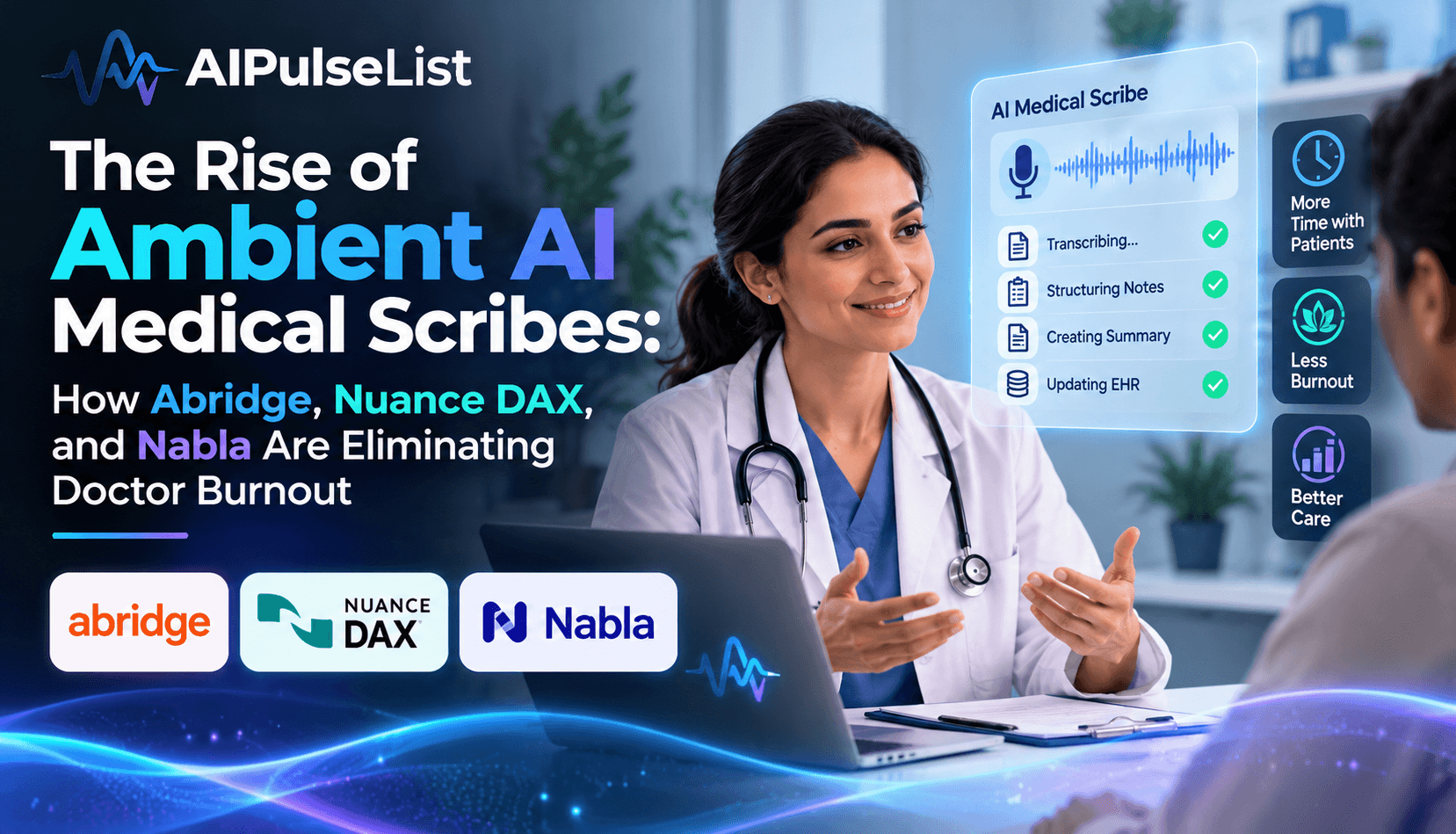
In 2026, Ambient Clinical Intelligence (ACI) has emerged as the most widely celebrated healthcare innovation of the century. Rather than typing notes, physicians simply place a smartphone or ambient microphone on the examination desk. As the doctor and patient converse naturally, the AI securely listens, ignores irrelevant casual small talk, structures the conversation into perfect clinical documentation, and stages the completed progress note directly inside Epic, Cerner, or AthenaHealth for quick physician review and signature.
💡 Pro-Tip for Healthcare Practices:
Explore our curated index in the Healthcare & Wellness AI Tools Directory to discover HIPAA-compliant transcription engines, diagnostic support tools, and clinic automation solutions.
How Ambient AI Scribes Actually Work in Clinical Practice
Ambient clinical scribes are far more sophisticated than standard audio transcription software. A simple dictation tool simply records words verbatim; an ambient medical scribe must perform high-level clinical comprehension across five distinct stages:
- Acoustic Separation & Speaker Diarization: Distinguishing between the voice of the attending physician, the patient, and a worried family member in an environment with ambient background noise (e.g., beeping monitors, coughing, air conditioning).
- Conversational Filtering: Discarding casual non-medical banter (such as discussing weekend plans or the local sports team) while capturing clinically relevant symptom timelines and medication compliance.
- Clinical Synthesis into Standardized Formats: Automatically structuring disparate conversation elements into rigorous medical documentation: History of Present Illness (HPI), Review of Systems (ROS), Physical Examination, and Assessment & Plan.
- Accurate ICD-10 & CPT Coding Suggestions: Recommending exact diagnostic and billing codes based solely on documented clinical findings, maximizing reimbursement compliance while eliminating fraudulent overcoding.
- EHR Bi-Directional Synchronization: Injecting the formatted clinical note directly into standard EHR fields, creating pending lab orders, and drafting plain-language patient after-visit summaries.
1. Abridge: The Evidence-Based Pioneer
Founded by practicing cardiologist Dr. Shivdev Rao, Abridge has rapidly established itself as the premier ambient AI scribe for major academic medical centers (including UPMC, Emory Healthcare, and Yale New Haven Health). Its deep, native partnership with Epic Systems makes it an enterprise favorite.
Standout Strengths:
- Auditable "Click-to-Source" Provenance: Abridge provides clickable links on every single medical phrase in the generated note. If an attending physician wonders why the note mentions "patient has experienced shortness of breath for 3 days," clicking that phrase immediately replays the exact 5-second audio snippet where the patient stated it.
- Extensive Multilingual Capability: Fluently processes doctor-patient encounters conducted in Spanish, Mandarin, Arabic, and over twenty other languages, generating pristine English documentation for the medical record.
- Proven Clinical Adoption: Clinical studies report an average 60% reduction in documentation time and an 86% decrease in physician administrative cognitive fatigue.
2. Nuance DAX Copilot (Microsoft Cloud for Healthcare)
As the creator of Dragon Medical One, Nuance has been the clinical documentation standard for over two decades. Following its acquisition by Microsoft, the Dragon Ambient eXperience (DAX) Copilot pairs Nuance's legendary acoustic vocabulary with OpenAI's most advanced reasoning foundation models.
Standout Strengths:
- Unrivaled EHR Integration: Embedded directly into Epic, Cerner, and MEDITECH with zero need to switch between third-party applications or copy-paste text buffers.
- Specialty-Specific Customization: Out-of-the-box templates and vocabulary fine-tunes tailored for over 70 medical specialties, from complex pediatric cardiology to orthopedic surgery.
- Enterprise Administrative Oversight: Comprehensive compliance dashboards allowing hospital chief medical officers to track documentation completion speed, coding compliance, and provider satisfaction metrics.
3. Nabla Copilot: The Fast, Agile Challenger
While Abridge and Nuance target massive hospital networks with enterprise contracts, Nabla Copilot (founded by former AI researchers from Meta AI) has captured the hearts of independent practices, concierge clinics, and telehealth startups.
Standout Strengths:
- Immediate 5-Minute Setup: Requires zero lengthy IT implementations or sales calls. Physicians can download the Chrome extension or mobile app and start charting on day one.
- Privacy-First Architecture: Nabla does not store audio recordings. Once the clinical note is generated, audio streams are permanently deleted from RAM, satisfying the strictest European GDPR and American HIPAA standards.
- Highly Accessible Pricing: Offers a free trial tier and transparent monthly subscriptions ($119/month per clinician), making ambient AI accessible to solo practitioners.
Comprehensive Feature Comparison Matrix
| Ambient Platform | Primary Target | EHR Integration Level | Note Generation Speed | Key Differentiator |
|---|---|---|---|---|
| Abridge | Large Hospital Networks & Health Systems | Deep Epic & Cerner Native Integration | Under 45 seconds | Click-to-Source Audio Verification |
| Nuance DAX Copilot | Enterprise Health Systems (Microsoft Ecosystem) | Seamless Dragon Medical Ecosystem | Under 60 seconds | 70+ Medical Specialty Templates |
| Nabla Copilot | Independent Practices & Telehealth Clinics | Chrome Extension / Athena / Web | Instantaneous (15–25 seconds) | Zero Audio Storage & Affordable Pricing |
Specialty-Specific Scribe Customization: Oncology, Pediatrics, and Surgery
A major advancement in 2026 ambient intelligence is specialized clinical ontological fine-tuning. General language models struggle with specialty vocabulary, often misinterpreting pediatric developmental milestones or surgical procedural shorthand.
Leading platforms now feature tailored specialty profiles:
- Pediatrics: Captures vaccine schedules, percentile growth curves, parental behavioral observations, and weight-based pediatric dosing calculations.
- Oncology: Maps complex multi-drug chemotherapy regimens, RECIST tumor progression criteria, staging classifications (TNM), and genomic sequencing biomarker reports.
- Orthopedic Surgery: Structures range-of-motion degree measurements, ligament stability maneuvers (Lachman, McMurray), and pre-operative joint replacement templates directly into structured clinical records.
HIPAA Compliance, Patient Consent, and Data Governance
Deploying recording devices in clinical examination rooms requires absolute adherence to medical ethics and data privacy regulations:
- Verbal or Signed Patient Consent: Best medical practice mandates informing patients before initiating ambient listening: "Mr. Davis, I use an AI assistant to take notes so I can focus on listening to you instead of typing on a computer. Is that okay with you?" Studies show that over 96% of patients enthusiastically agree.
- Business Associate Agreements (BAAs): Enterprise healthcare organizations must ensure the AI vendor signs a strict BAA guaranteeing zero retention of protected health information (PHI) for model training purposes.
- Physician Review as the Ultimate Safeguard: The ambient AI scribe is an assistant, not an autonomous clinician. The attending physician must read, verify, and digitally sign every note, maintaining absolute responsibility for diagnostic accuracy and treatment plans.
The Future: From Passive Scribes to Proactive Clinical Copilots
As ambient intelligence matures, these systems are evolving beyond retrospective charting into real-time clinical decision support. Future iterations will quietly alert physicians to potential drug-drug interactions, suggest guideline-recommended preventative cancer screenings during routine wellness visits, and draft personalized care instructions that patients can easily understand on their mobile phones.
Conclusion
Ambient AI medical scribes represent technology at its absolute best: an innovation that does not commoditize humans, but restores humanity to medicine. By returning the physician's gaze from the computer keyboard back to the patient's eyes, ambient intelligence revitalizes the healing relationship that inspired doctors to enter the medical profession in the first place.