
The High-Volume Dilemma of Modern Talent Acquisition
In 2026, talent acquisition teams face an unprecedented operational paradox. On one side, remote work and automated job-application tools (such as browser extensions that submit hundreds of AI-tailored resumes in a single click) have created staggering inbound application volumes. A single open software engineering or marketing position at an attractive technology company frequently attracts between 1,500 and 4,000 inbound applicants within seventy-two hours of posting.
On the other side, human recruiting teams simply do not have the manual bandwidth to carefully read thousands of resumes. When recruiters spend an average of six to eight seconds glancing at a resume, qualified candidates from unconventional backgrounds are overlooked, while charismatic applicants who master buzzword-stuffing slip through the cracks.
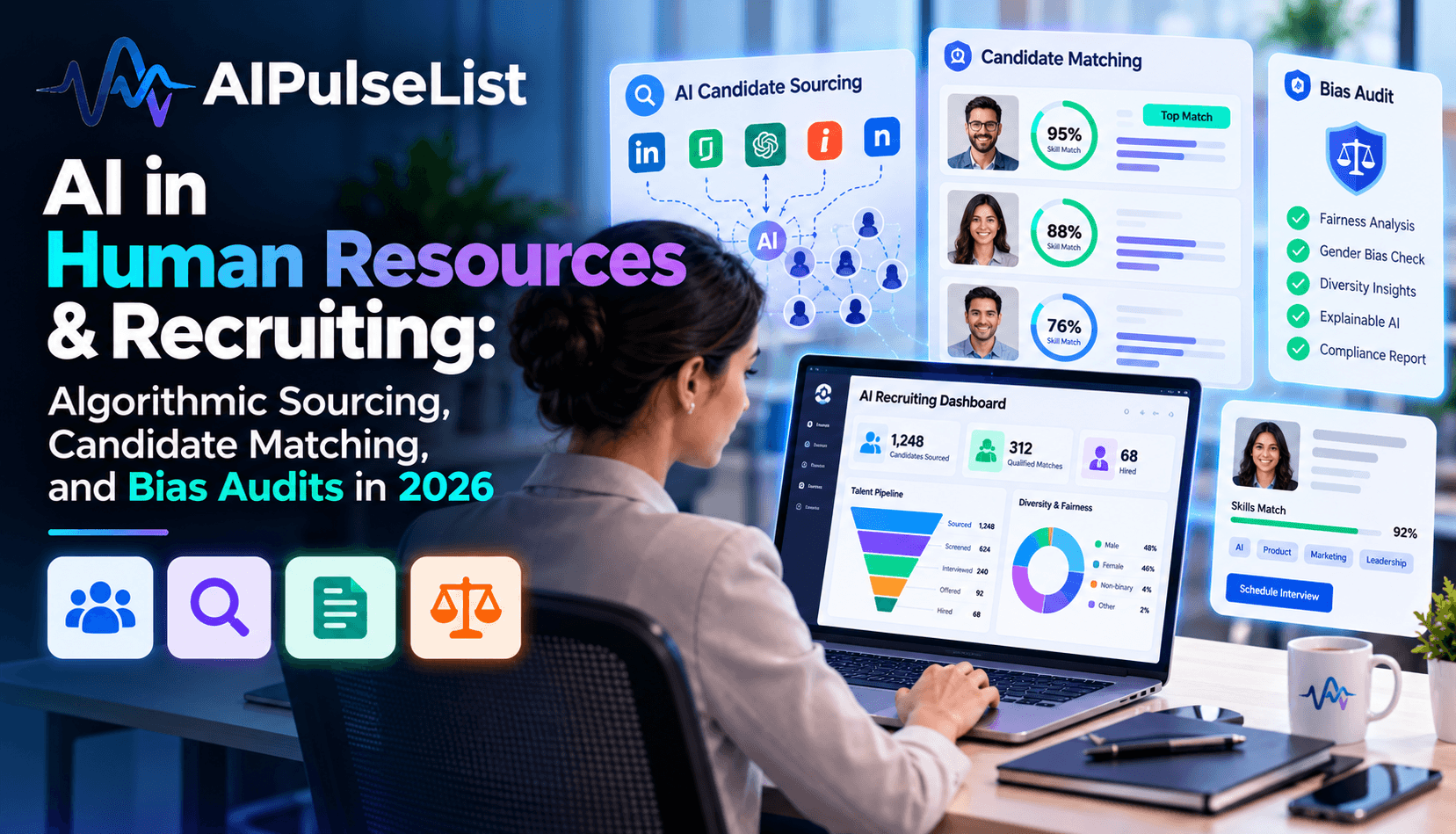
In response, modern People Operations leaders are deploying sophisticated Talent Intelligence & Recruiting AI Platforms. When configured with rigorous ethical safeguards, these systems source passive talent across open-source code repositories, match candidate competencies against role requirements with semantic depth, and conduct structured asynchronous interview evaluations—all while maintaining strict regulatory compliance against algorithmic discrimination.
💡 Pro-Tip for Talent Leaders:
Explore our curated directory in the HR & Recruiting AI Tools Directory to compare talent intelligence suites, onboarding bots, and performance management platforms.
The Four Pillars of Ethical AI Recruitment
Deploying artificial intelligence in talent acquisition demands extreme care, given both legal liability under the Equal Employment Opportunity Commission (EEOC) and corporate moral responsibility. Legitimate talent intelligence software adheres to four core capabilities:
- Semantic Skills Matching (Beyond Keyword Search): An applicant whose resume lists "Golang, Kubernetes, distributed raft consensus, and high-throughput gRPC" is recognized as an ideal fit for a distributed systems backend role, even if the specific words "Enterprise Backend Engineer" do not appear verbatim.
- Passive Talent Discovery & Enrichment: Synthesizing public technical signals from GitHub commits, technical patent filings, conference talks, and open-source contributions to discover qualified candidates who are not actively searching job boards.
- Structured, Objective Interview Intelligence: Recording live or asynchronous interviews, generating accurate transcripts, and evaluating answers solely against pre-defined, job-relevant competency rubrics rather than unconscious interviewer gut-feel.
- Continuous Disparate Impact Auditing: Mathematically auditing applicant pass-through rates across gender, racial, and age demographic groups to verify compliance with the "Four-Fifths Rule" and statutory bias audit laws (such as NYC Local Law 144).
1. Eightfold.ai: The Enterprise Talent Intelligence Benchmark
Eightfold is widely considered the pioneer of deep neural talent intelligence, serving Fortune 500 corporations like Micron, Vodafone, and Capital One. Built on billions of anonymized career trajectory data points, Eightfold models career potential rather than mere past job titles.
Standout Strengths:
- Career Trajectory & Upskilling Forecasting: Evaluates not just what skills a candidate possesses today, but their statistical propensity to rapidly master adjacent skills based on their career path.
- Equal Opportunity Algorithms: Features native masking algorithms that strip names, graduation years, gender indicators, and home zip codes from candidate evaluation views to completely eliminate early-stage screening bias.
- Internal Talent Mobility: Automatically matches current enterprise employees to internal project openings and career promotions, dramatically reducing expensive executive turnover.
2. Metaview: The AI Copilot for Live Interviews
While Eightfold focuses on sourcing and resume matching, Metaview has revolutionized the actual interview stage. Favored by high-velocity startups like Brex, Quora, and Ramp, Metaview serves as a silent, intelligent note-taker during live Zoom, Google Meet, or phone interviews.
Standout Strengths:
- Automated Interview Summaries: Generates rigorous, structured interview scorecards within sixty seconds of the call ending. Interviewers can focus 100% of their attention on having an engaging, deep conversation with the candidate rather than furiously typing notes.
- Competency Rubric Alignment: Organizes candidate responses directly under your company's pre-defined evaluation categories (e.g., "System Design," "Conflict Resolution," "Communication Clarity").
- Interviewer Quality Training: Flags when interviewers talk too much (e.g., spending 60% of the interview talking instead of listening) or ask biased, leading questions.
3. HireVue: The Video Assessment & Skill Verification Platform
HireVue is the long-standing enterprise leader in high-volume campus recruiting and structured video assessments, serving major airlines, healthcare conglomerates, and global financial institutions.
Standout Strengths:
- Standardized Asynchronous Assessments: Allows thousands of applicants to record answers to identical, structured interview questions on their own schedule, eliminating scheduling delays.
- Coding & Practical Skill Challenges: Seamlessly combines live coding environments, situational judgment tests, and video explanations into a single evaluation platform.
- Rigorous Independent Bias Audits: Regularly undergoes comprehensive third-party algorithmic audits to guarantee full compliance with international anti-discrimination legislation.
Platform Comparison Matrix for People Leaders
| Recruiting Platform | Primary Focus Area | Key Advantage | ATS Integrations | Ideal Company Size |
|---|---|---|---|---|
| Eightfold.ai | Enterprise Sourcing & Talent Mobility | Skills-based matching & bias masking | Workday, SAP SuccessFactors, Greenhouse | 1,000+ employees |
| Metaview | Interview Note-Taking & Scorecards | 1-Click AI scorecards & human focus | Greenhouse, Lever, Ashby, Workable | 50 – 2,000 employees |
| HireVue | High-Volume Video & Skill Screening | Standardized asynchronous assessments | All major enterprise ATS platforms | Enterprise retail, finance & healthcare |
Auditing Disparate Impact: The Four-Fifths Rule in Algorithmic Hiring
In jurisdictions worldwide, regulatory authorities mandate that automated employment decision tools (AEDTs) prove statistical neutrality. Under EEOC enforcement guidelines and New York City Local Law 144, employers must calculate the Impact Ratio (Selection Rate) across all demographic groups:
Impact Ratio = (Selection Rate of Protected Demographic Class) / (Selection Rate of Highest-Selected Demographic Class)
If the resulting ratio falls below 0.80 (80%), the algorithm is classified as exhibiting disparate impact. Certified 2026 talent platforms automatically calculate these ratios daily in background analytics dashboards, proactively alerting recruiters if certain assessment questions or scoring thresholds are inadvertently penalizing specific demographic cohorts.
Legal Compliance Checklist: Protecting Against Hiring Bias
To deploy AI in talent acquisition safely and legally, People Operations leaders must enforce this compliance framework:
- Never Allow Fully Autonomous Rejection: An AI system should score, summarize, and rank applicants; it must never be permitted to autonomously reject candidates without human recruiter confirmation.
- Publish Clear Applicant Notices: Clearly notify candidates on your career portal that artificial intelligence tooling is utilized to assist in scheduling and transcript generation.
- Conduct Annual Independent Disparate Impact Audits: Hire external auditing firms to calculate selection ratios across protected demographic classes and publish results in accordance with local regulations.
- Standardize Competency Rubrics Before Sourcing: Never allow an AI to evaluate candidates against vague criteria like "cultural fit." Define explicit behavioral competencies and technical milestones.
Conclusion
When deployed responsibly with ethical guardrails and human oversight, artificial intelligence does not depersonalize recruitment; it humanizes it. By eliminating the administrative burden of manual resume triage and frantic note-taking, talent professionals can dedicate their time to what truly matters: having meaningful conversations, building authentic relationships, and creating exceptional candidate experiences that attract top-tier talent.