

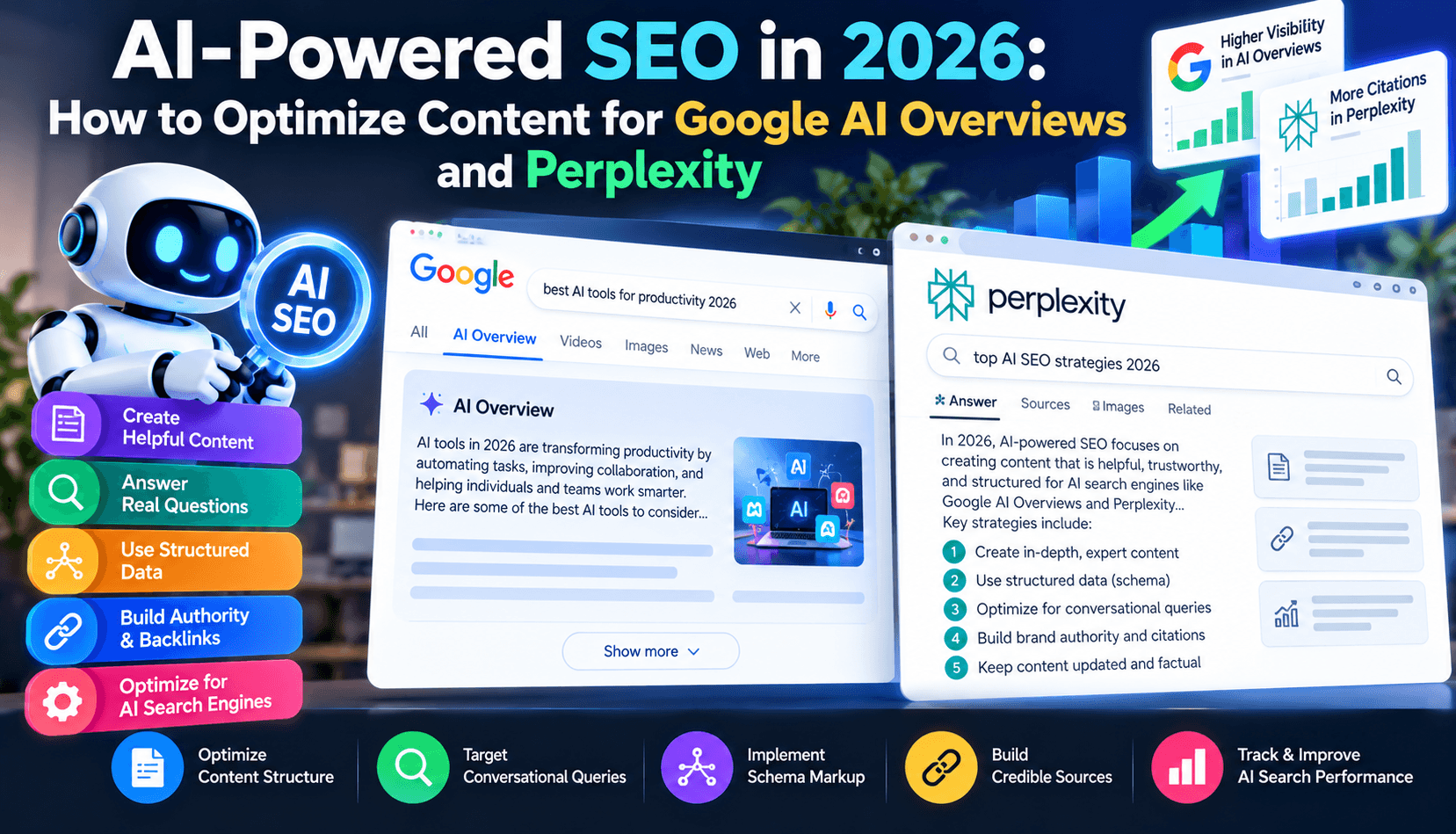
The Death of the Ten Blue Links
For more than twenty-five years, Search Engine Optimization (SEO) adhered to a clear, consistent formula: identify high-volume keywords, write keyword-rich articles, build backlinks from authority domains, and earn a coveted top-3 spot among Google's famous "ten blue links."
In 2026, that traditional search paradigm has fundamentally changed. Today, more than 40% of all informational search queries never result in a click to an external website. Instead, users receive synthesized, real-time answers delivered directly by Google AI Overviews, Perplexity AI, and OpenAI SearchGPT.
To survive and dominate in this new search environment, digital marketers and web publishers must transition from traditional SEO to Generative Engine Optimization (GEO). In this comprehensive guide, we explain how modern answer engines select their citations and reveal the exact content architecture required to win prominent placements in AI answer boxes.
What is Generative Engine Optimization (GEO)?
GEO is the practice of structuring digital content so that generative large language models easily discover, parse, trust, and cite your domain as an authoritative ground-truth source when synthesizing answers for users.
While traditional SEO algorithms ranked pages based heavily on domain authority metrics and anchor text backlink ratios, AI answer engines evaluate pages based on semantic information density, factual verifiability, and logical clarity.
The 4 Core Pillars of GEO Success
1. High Information Density in the "Answer Zone"
Generative engines despise fluff. If your article begins with three paragraphs of generic throat-clearing ("Since the dawn of time, software has been important..."), an AI crawler will discard your page. Answer engines cite pages that deliver direct, unambiguous answers within the very first two sentences following a heading:
- Bad Formatting: A 400-word story about why you decided to test two models, buried beneath multiple intro sections.
- GEO-Optimized Formatting: A heading phrased as a question (e.g., "What is the token cost of Claude 3.7 Sonnet?") followed immediately by: "Claude 3.7 Sonnet costs $3.00 per million input tokens and $15.00 per million output tokens, making it 50% cheaper than predecessor flagship models."
2. Proprietary First-Party Data & Hands-On Benchmarks
AI search models are trained to avoid citing regurgitated summaries. If your article simply rephrases Wikipedia or product documentation, answer engines will cite the primary source instead. To earn citations, publish original first-party data: hands-on latency tests, real user survey figures, or unique benchmark comparisons.
3. Semantic Entity Hierarchy & Schema.org Markup
LLMs consume content through Knowledge Graphs. You must make your content's entities obvious by wrapping your pages in rich, valid JSON-LD schemas:
{ "@context": "https://schema.org", "@type": "TechArticle", "headline": "AI-Powered SEO in 2026: Optimizing for Perplexity", "author": { "@type": "Organization", "name": "AI Pulse Editorial Board", "url": "https://www.aipulselist.com" }, "publisher": { "@type": "Organization", "name": "AI Pulse", "logo": { "@type": "ImageObject", "url": "https://www.aipulselist.com/uploads/logo.png" } }, "mainEntityOfPage": "https://www.aipulselist.com/blog/ai-powered-seo-perplexity-google-overviews" }
4. Author Persona and Authoritative Attribution
Google's E-E-A-T (Experience, Expertise, Authoritativeness, and Trustworthiness) standards are amplified in AI search. Every guide should feature a transparent author byline detailing the writer's professional credentials, verified LinkedIn/Twitter profiles, and hands-on testing methodology.
Traditional SEO vs. Generative Engine Optimization (GEO)
| Evaluation Metric | Traditional Google SEO | Generative Engine Optimization (GEO) |
|---|---|---|
| Primary Ranking Goal | Rank in Top 3 organic blue links | Earn primary citation card in AI summary |
| Keyword Strategy | Exact match keywords & search volume | Semantic intent & natural language questions |
| Content Structure | Long-form comprehensive articles | High information density, bullet points, tables |
| Backlink Influence | Domain Authority (DA) & anchor text | Brand entity mentions & co-citation frequency |
| User Click-Through Behavior | Browsing multiple search listings | Direct deep-link click from cited reference |
A 5-Step GEO Audit Checklist for Your Articles
- Convert Subheadings into Natural Questions: Instead of a heading like "Pricing Plans", use "How Much Does Tool X Cost in 2026?".
- Lead with the Direct Answer: Answer the question directly in sentence #1, then provide supporting context in subsequent lines.
- Include Structured Comparison Tables: AI models extract table rows and columns with extraordinarily high fidelity when compiling answers.
- Add a Dedicated FAQ Section: Place 3–5 common user objections or queries at the footer of every guide, structured with clean Schema.org markup.
- Eliminate "AI Slop" Buzzwords: Remove words like "delve", "tapestry", "revolutionize", and "game-changer". Write with clean, authoritative, journalistic economy.
Reverse-Engineering Answer Engine Citation Algorithms (Perplexity vs. Google AI)
To consistently earn citations, you must understand how generative engines retrieve and rerank web documents. The pipeline typically follows three distinct computational stages:
- Stage 1: Multi-Query Search Fan-Out: When a user types a natural question, the engine's query reformulator expands it into 4–6 distinct sub-queries (e.g. asking for pricing, pros/cons, user reviews, and competitor comparisons simultaneously).
- Stage 2: Dense Passage Vector Retrieval: The crawler fetches top documents and splits them into 200–300 word chunks. These chunks are converted into numerical embeddings and matched against the user's semantic query vector.
- Stage 3: Cross-Encoder Reranking: High-performance rerankers (like Cohere Rerank or BGE Reranker) score the semantic relevancy of each chunk. The top 3–5 highest-scoring passages are fed directly into the model's synthesis context window as cited ground truth.
If your content hides important statistics inside 1,000-word uninterrupted paragraphs, the reranker gives that chunk a lower relevancy density score. Structure your paragraphs into concise, punchy 2–3 sentence modules to maximize passage retrieval scores.
Programmatic GEO: Scaling Directory Architecture for Answer Engines
Directory and aggregator platforms like AI Pulse enjoy an enormous structural advantage in GEO because users frequently ask answer engines for comparative lists (e.g., "What are the best free alternatives to Midjourney?"). To ensure your programmatic pages are cited:
- Standardize SoftwareApplication Microdata: Ensure every tool profile page includes valid JSON-LD schemas declaring applicationCategory, operatingSystem, offers (pricing plans), and verified aggregate ratings.
- Implement Direct Versus Tables: Generate side-by-side alternative comparison tables that answer engines can parse directly into synthesized bullet points.
- Maintain Dynamic Canonical Breadcrumbs: BreadcrumbList schemas help crawler LLMs map the taxonomy hierarchy from broad categories down to specific software alternatives.
Frequently Asked Questions (FAQ)
Does Perplexity give referral traffic to cited websites?
Yes. Perplexity displays prominent domain citation pills above and within its synthesized answers. Users searching for specific tool reviews, pricing tables, or tutorials routinely click those citations to verify primary sources, generating high-intent referral traffic.
Does blocking AI web scrapers in robots.txt impact traditional Google search rankings?
Blocking generic crawlers (like GPTBot, CCBot, or ClaudeBot) does not directly hurt your traditional Google organic rank, but it completely prevents OpenAI SearchGPT and Anthropic from citing your domain in answers. If your target audience uses AI answer engines for product discovery, blocking these crawlers cuts off a massive pipeline of high-intent referral traffic.
Can I automate my entire blog with AI and still rank in Google AI Overviews?
No. Google explicitly penalizes mass-generated, low-effort programmatic content that lacks original human insight or first-hand experience. Using AI to research and outline is fantastic, but articles must feature original testing, authentic voice, and editorial oversight.
How do I test if my website is cited in AI search engines?
Conduct regular prompt monitoring across Perplexity and SearchGPT by entering high-intent queries related to your niche (e.g., "What are the best AI code assistants in 2026?"). Observe which domains appear in the footnote citation list and reverse-engineer their content structure.
What role do internal links play in GEO?
Internal links help search engine bots map the contextual relationships between different entities on your website. Linking related guide topics to specific tool review pages helps answer engines identify your directory as a comprehensive subject-matter cluster.
Conclusion
Search is not dying; it is evolving. By optimizing your pages for high informational density, original benchmark data, and structured semantic tables, you can position your directory as an authoritative source in the era of AI-driven search.