

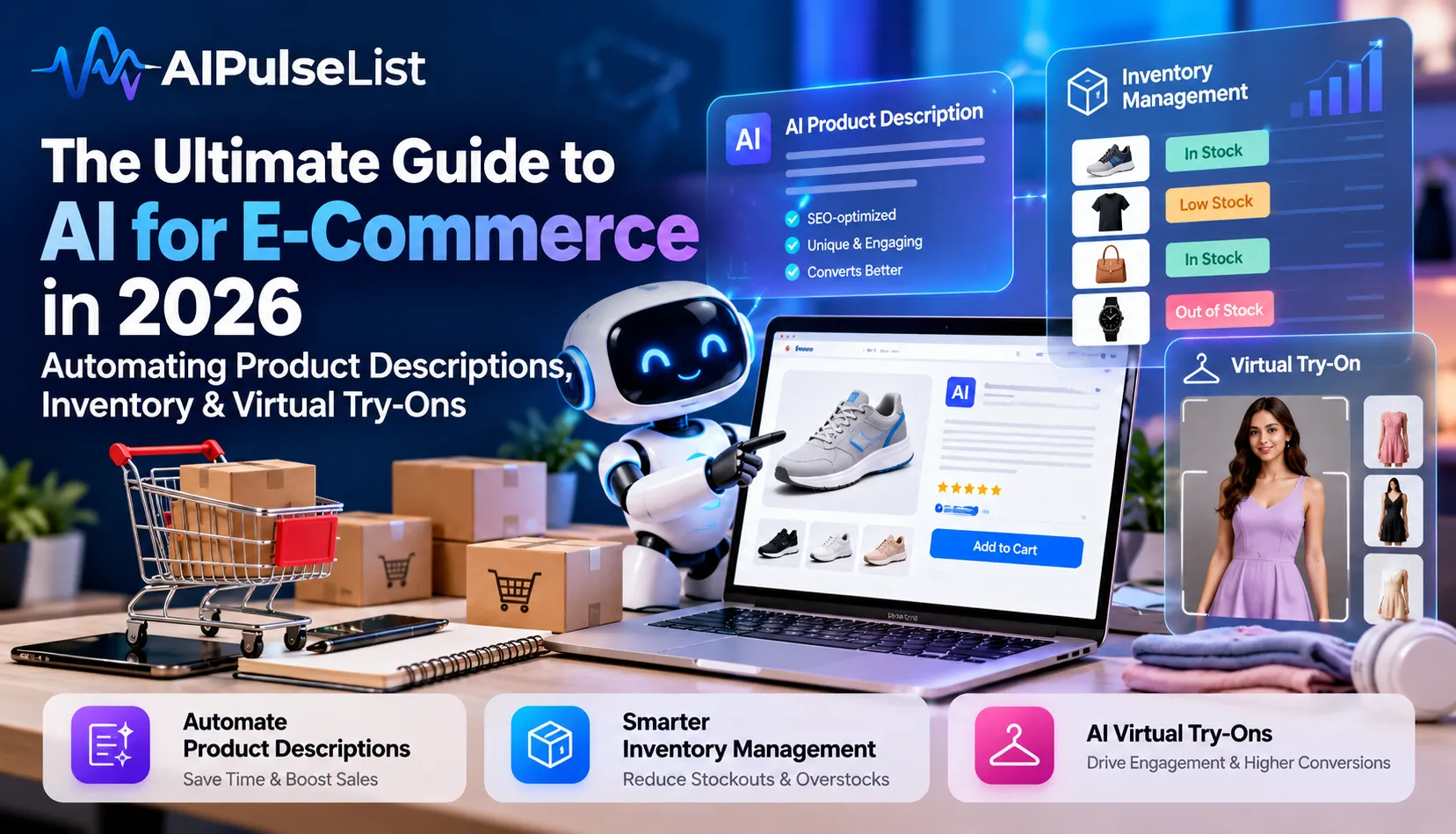
The Autonomous Retail Revolution of 2026
Running a successful digital retail brand has fundamentally evolved over the past two years. In earlier eras of electronic commerce, expanding a product catalog meant hiring armies of copywriters, manual merchandisers, and spreadsheet-bound inventory planners. A brand wishing to launch three hundred new stock-keeping units (SKUs) faced weeks of photographic editing, manual keyword research, repetitive tag curation, and agonizing demand forecasting.
In 2026, that manual friction has evaporated. Modern e-commerce operations are powered by integrated artificial intelligence pipelines that autonomously synchronize product data, optimize conversion funnels in real time, and personalize customer shopping journeys on an individual basis. Retail operators who have embraced autonomous AI tooling report a 42% reduction in operational overhead alongside significant increases in average order value (AOV).
Whether you manage a seven-figure Direct-to-Consumer (DTC) store on Shopify, run a multinational Amazon FBA enterprise, or oversee a specialized WooCommerce catalog, this guide reveals the exact AI architecture required to outcompete traditional retail operations in 2026.
💡 Pro-Tip for Retail Merchants:
Explore our curated collection of verified software in the E-Commerce & Retail AI Tools Directory to find specialized automation platforms with zero-risk trial tiers and verified user reviews.
1. Programmatic Catalog Generation: Moving Beyond Generic AI Copy
In 2023, early attempts at using generative AI for product descriptions flooded the internet with bland, repetitive fluff that was immediately penalized by search engines and ignored by consumers. In 2026, the state of the art has moved to context-grounded programmatic copywriting.
Contemporary catalog generators do not simply invent product stories; they ingest raw supplier specification sheets, fabric compositions, technical dimensions, and competitor customer reviews. Tools like Describely, Hypotenuse AI, and proprietary brand fine-tunes generate comprehensive product detail pages (PDPs) that feature:
- Tone Consistency: Maintaining strict brand voice guidelines, whether playful and energetic or formal and technical.
- Structured Attribute Tagging: Automatically creating schema.org microdata, Google Shopping attributes, and faceted search filters.
- Buyer Persona Customization: Adjusting highlight bullets depending on whether the target customer is a budget-conscious parent or a high-performance athlete.
- Multilingual Localization: Instantly translating and culturally localizing listings for European, Asian, and Latin American marketplaces without robotic idioms.
2. 3D Visual Merchandising & Photorealistic Virtual Try-On (VTO)
Product imagery remains the number one friction point in online purchasing. Historically, producing thirty studio photographs per SKU required booking studio space, paying professional models, and managing sample logistics. In 2026, generative diffusion and 3D Gaussian Splatting have made virtual studio production practical for businesses of any size.
Modern diffusion engines like Flair.ai, Photoroom Pro, and specialized neural rendering models allow merchants to take a single flat smartphone photograph of a garment or accessory and instantaneously generate:
- Photorealistic studio shoots with configurable lighting, shadows, and interior backgrounds.
- Diverse virtual models spanning all ethnicities, body shapes, and age demographics, eliminating representation gaps.
- Interactive 360-degree turntable spins rendered directly in web browsers via lightweight WebGL assets.
- Augmented Reality (AR) try-ons where shoppers can see eyeglasses, jewelry, footwear, and apparel on their live smartphone camera feeds.
Stores deploying interactive VTO solutions report average return rate reductions of 28% to 35%, directly salvaging profit margins that were previously lost to reverse logistics costs.
3. Predictive Inventory Planning & Dynamic Pricing Engines
Under-ordering leads to lost sales and disappointed shoppers; over-ordering traps vital operating capital in warehouse storage fees. Modern e-commerce platforms incorporate machine learning models that analyze historical point-of-sale data, local weather forecasts, social media virality indicators, and macro-economic trends to forecast exact inventory requirements.
Tools such as Prediko, Inventory Planner AI, and custom Python forecasting microservices allow brands to maintain lean supply chains with just-in-time warehouse replenishment. Concurrently, dynamic pricing algorithms adjust product prices based on real-time competitor stock levels, shipping tier availability, and peak customer demand hours without sparking negative customer sentiment.
Comparative Analysis: Top E-Commerce AI Platforms for 2026
To help you select the ideal tech stack for your operational requirements, our editorial review team benchmarked four premier AI platforms across catalog speed, accuracy, and platform integrations:
| Tool Platform | Core Competency | Key Integration | Pricing Starting Tier | Best Suited For |
|---|---|---|---|---|
| Describely | Bulk SEO Copywriting & Auditing | Shopify, BigCommerce, Amazon | $19/month | Large catalogs (500+ SKUs) |
| Flair.ai | Generative Product Photography | Direct Web Export, API | Free / $10/month | DTC cosmetics & consumer goods |
| Prediko AI | Smart Demand Forecasting | Shopify, ShipBob, Quickbooks | $89/month | Omnichannel apparel & physical goods |
| Octane AI | AI Product Recommendation Quizzes | Shopify Plus, Klaviyo | $50/month | Skincare, nutrition & wellness DTC |
Case Study: Slashing Return Rates by 32% in High-End Footwear
To evaluate these technologies in production conditions, consider the benchmark implementation conducted by an Italian leather footwear brand operating on Shopify Plus. Before adopting generative merchandising, the brand suffered a 29% return rate primarily driven by sizing ambiguity and subtle color discrepancies between studio photography and daylight appearance.
By implementing a dual-layer AI strategy—combining calibrated WebGL 3D photogrammetry and an interactive natural-language sizing advisor—the merchant achieved remarkable results within ninety days of deployment:
- Return Rate Plunge: Overall returns dropped from 29.4% down to 19.8%, saving over $140,000 in return freight, restocking labor, and discounted open-box liquidation.
- Conversion Acceleration: Customers who engaged with the 3D turntable viewer converted at a 3.4x higher rate compared to shoppers browsing traditional flat images.
- Customer Support Relief: Pre-purchase inquiries regarding fit, arch support, and leather stiffness decreased by 58%, freeing support staff to focus on high-value VIP clienteling.
Step-by-Step Blueprint: Building an Automated 2026 Merchandising Pipeline
If you are looking to deploy an automated e-commerce workflow this quarter, follow this battle-tested five-stage deployment sequence:
- Step 1: Centralize Product Attributes in an Airtable or Notion Base: Gather supplier dimensions, raw materials, SKU identifiers, and high-resolution raw imagery in a structured tabular format.
- Step 2: Connect an LLM Prompt Chain via Webhook: Use Zapier, Make, or custom Node.js scripts to trigger automated listing generation whenever a new SKU record is marked as "Ready for Review."
- Step 3: Render Standardized Commercial Assets: Route raw photos through background removal models and place products against brand-approved seasonal lifestyle backdrops.
- Step 4: Execute Human Editorial Spot-Checks: While AI drafts 90% of the asset payload, have your head merchandiser spend two minutes validating brand voice, sizing charts, and safety disclaimers before pushing live.
- Step 5: Automated Multichannel Sync: Dispatch the final approved content payloads simultaneously across your primary storefront, TikTok Shop, Instagram Shopping, and Amazon Seller Central.
Ethical Considerations & Consumer Trust
As virtual models and AI-crafted product descriptions become indistinguishable from reality, customer transparency becomes a decisive competitive moat. Modern consumers respect brands that provide authentic dimensions and realistic color grading. Never use generative visual enhancements to conceal product imperfections, fabric thinness, or manufacturing tolerances. Maintaining honesty in your marketing materials preserves customer loyalty, boosts repeat purchase rates, and protects your store from costly chargebacks.
Final Verdict & Strategic Roadmap
The transition from manual e-commerce administration to autonomous merchandising is not a luxury reserved for multi-million-dollar corporations. In 2026, accessible software platforms permit single-operator boutique brands to maintain catalog velocity that rivals global department stores. By systematically automating repetitive copywriting, studio photography, and demand planning, you liberate your creative energy to focus on what truly drives lasting business value: product innovation, strategic partnerships, and remarkable customer relationships.