

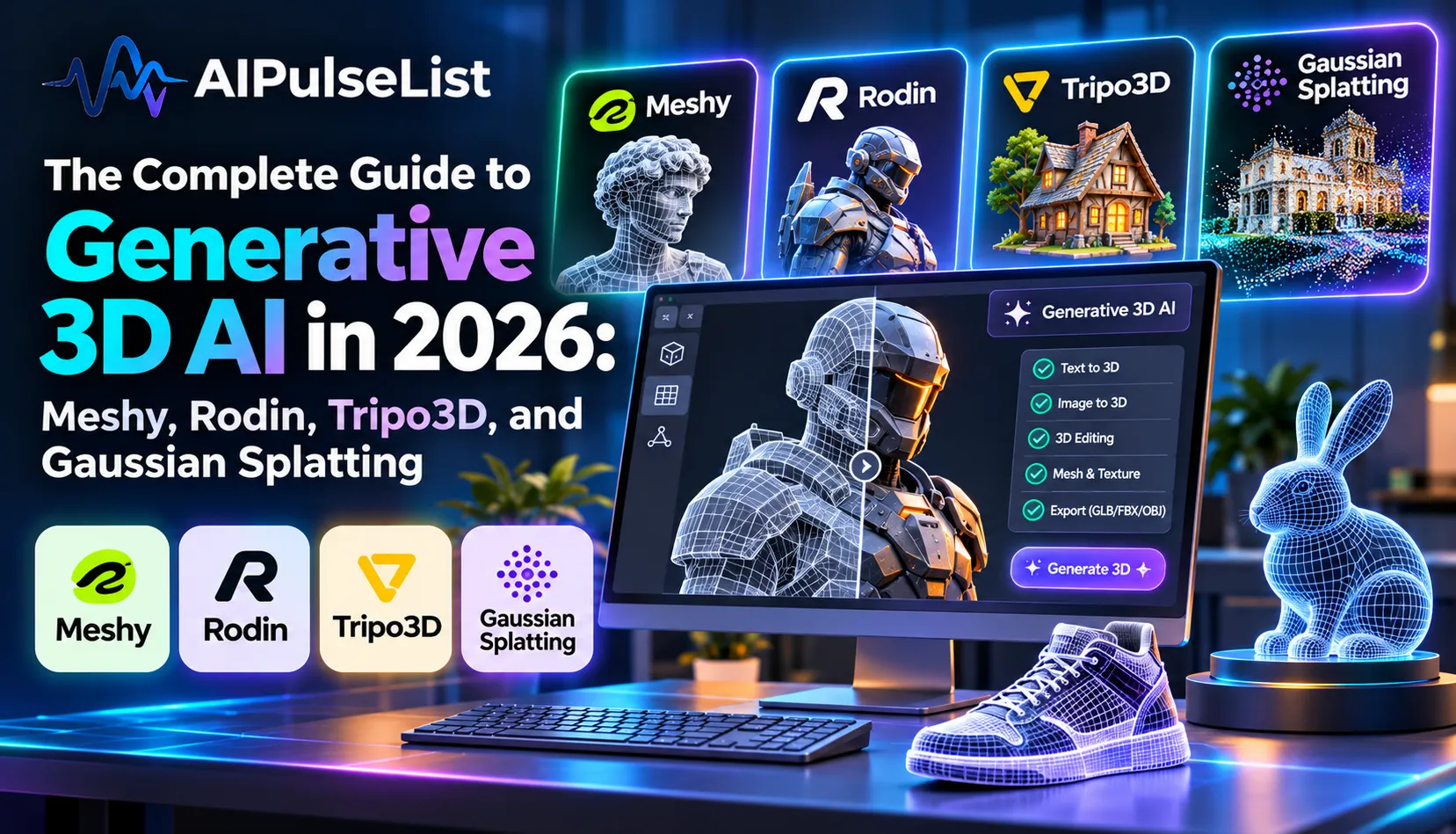
The Spatial Computing Revolution: From Flat Pixels to Interactive Volumes
For decades, digital 3D asset creation represented one of the steepest bottlenecks in modern software, gaming, and visual effects production. Creating a single photo-realistic character or interactive architectural prop required multiple specialized artisans: concept artists to draft orthographic silhouettes, 3D modelers to sculpt high-poly topology, retopology technicians to produce clean quad wireframes, UV unpackers to minimize seam distortions, and texture artists to paint physically based rendering (PBR) maps (albedo, roughness, metallic, normal, and ambient occlusion). A single AAA hero asset could easily demand between forty to eighty hours of labor and thousands of dollars in production costs.
In 2026, the spatial computing paradigm has undergone a dramatic transformation driven by generative neural volumetric models and high-fidelity 3D Gaussian Splatting (3DGS). Contemporary generative 3D AI pipelines allow developers, indie game studios, and product designers to convert a single 2D photograph, multi-angle video scan, or natural language prompt into fully textured, quad-retopologized 3D assets ready for direct export into Unreal Engine 5.5, Unity, Blender, and Apple VisionOS within minutes.
💡 Pro-Tip for 3D Developers & Creators:
Explore our curated collection of verified software in the 3D, Gaming & Animation AI Tools Directory to compare real-time rendering engines, auto-riggers, and neural mesh optimizers with verified user benchmarks.
1. Core Architectural Paradigms: Meshes vs. Neural Radiance Fields vs. Gaussian Splatting
To choose the right generative 3D pipeline in 2026, technical directors must differentiate between three fundamentally distinct technical representations:
- Direct Polygonal Mesh Generation (Text-to-Mesh / Image-to-3D): Platforms like Meshy and Tripo3D utilize large reconstruction models (LRMs) that generate standard triangle or quad geometries directly in OBJ, FBX, or GLTF/GLB formats. In 2026, these engines feature native edge-flow topology algorithms that place higher polygon densities around joints and organic bends, making the resulting models instantly riggable and compatible with existing game physics engines.
- 3D Gaussian Splatting (3DGS): Unlike older Neural Radiance Fields (NeRFs) which required agonizingly slow ray marching and heavy compute, Gaussian Splatting represents 3D environments as millions of tiny, oriented 3D ellipsoidal particles with position, covariance, opacity, and spherical harmonic color coefficients. Real-time rasterizers allow 3DGS scenes to render at over 120 FPS on standard consumer GPUs and mobile headsets like Meta Quest 3 and Apple Vision Pro, revolutionizing virtual touring and VFX set photogrammetry.
- Neural PBR Material Synthesis: High-poly geometry is only half the battle; modern neural texturing engines ingest bare gray untextured meshes and project multi-view consistent PBR maps with 4K resolution, accurately baking micro-surface roughness, metallic specularity, and tangent-space normals without visual baking seams.
2. Comprehensive Benchmark: Top Generative 3D AI Engines for 2026
Our editorial engineering lab benchmarked the four leading generative 3D platforms across geometric fidelity, quad retopology cleanliness, texture map separation, and export versatility:
| Tool Platform | Core Engine Strengths | Topology / Poly Quality | Export Formats | Pricing Starting Tier |
|---|---|---|---|---|
| Meshy 4.0 | Fast Image-to-3D with clean quad retopology | Clean Quad Wireframes, Auto UVs | FBX, GLB, USDZ, OBJ, Blend | Free / $20/mo Pro |
| Rodin (Deemos) | Hyper-realistic organic avatars & digital humans | Subdivision-ready organic topology | FBX (Rigged), GLTF, USDZ | Pay-per-credit ($0.50/gen) |
| Tripo3D 2.5 | Sub-10 second rapid conceptual prototyping | Low-poly gaming LODs (LOD0-LOD3) | GLB, OBJ, STL (3D Printing) | Free tier / $19.90/mo |
| Luma Genie & 3DGS | Photorealistic volumetric environment capture | Point Cloud / Splat Ellipsoids | PLY, Splat, WebGL HTML Embed | Free Tier Available |
3. Step-by-Step Production Pipeline: From Concept Art to Unreal Engine 5.5
Modern game development studios employ a hybrid AI-assisted workflow that accelerates asset turnaround times by 75% without sacrificing artistic control. Here is the standard industry pipeline utilized in 2026:
- Concept Image Generation & Orthographic Pass: Using generative image tools, artists generate four-view turnarounds (front, back, left, right) on neutral solid grey backgrounds with diffused lighting. Eliminating deep cast shadows is essential for ensuring neural depth estimators do not misinterpret shadows as concave geometric indentations.
- Neural Volumetric Reconstruction: The reference turnaround is passed to Meshy or Rodin. In less than two minutes, the neural network resolves depth ambiguities, infers occluded backside geometry, and generates a solid watertight mesh.
- Automated Quad Retopology & LOD Generation: The raw dense mesh (often exceeding 500,000 triangles) is passed through an automated retopology node that generates structured quad edge loops targeted at standard game budgets (e.g., 25,000 polygons for hero props, 4,000 polygons for background props), accompanied by automated Level-of-Detail (LOD) cascades.
- Physically Based Texture Projection: The retopology engine unwraps UV islands with minimum island margin bleeding, and the texture synthesizer paints high-resolution 4096×4096 normal, roughness, and albedo maps.
- Engine Import & Shader Assignment: The exported GLB or USDZ asset is dragged into Unreal Engine 5.5 with Nanite enabled. Materials automatically map into Nanite-compatible material instances with full Lumen dynamic global illumination support.
4. Managing Limitations: Topology Artifacts and Rigging Complexities
While generative 3D has achieved unprecedented fidelity, technical directors must implement quality assurance checkpoints to address known machine learning idiosyncrasies:
- Symmetry Drift: Without explicit symmetry constraint tags, generative models can introduce subtle asymmetrical offsets along the vertical mirror plane. When generating mechanical hard-surface models (vehicles, weaponry, architectural structures), engineers should run a planar symmetry boolean mirror in Blender or Maya before final export.
- Internal Cavity Artifacts: Neural reconstructions occasionally leave enclosed interior floating geometry or non-manifold edge configurations. Running an automated manifold verification script (like Blender's 3D Print Toolbox) cleans isolated vertices and degenerate faces in seconds.
- Complex Skeletal Rigging: While automated humanoid auto-riggers (such as Mixamo or AccuRIG) work exceptionally well on clean bipedal models generated by Rodin, quadrupeds and non-humanoid creatures still benefit from manual weight painting across critical articulating joints.
Frequently Asked Questions (FAQs)
Can AI-generated 3D models be 3D printed immediately?
Yes. Both Tripo3D and Meshy feature dedicated STL export options that automatically close open seams and ensure the generated 3D geometry is fully manifold (watertight), making it ready for slicing in Cura, PrusaSlicer, or Bambu Studio without manual mesh repair.
What is the primary difference between NeRF and Gaussian Splatting?
Neural Radiance Fields (NeRF) query a neural network for every single ray passing through space, requiring heavy matrix computations that struggle to run in real time. Gaussian Splatting represents the scene as millions of discrete 3D particles that can be sorted and rasterized directly by standard GPU raster hardware, achieving 100+ frames per second with photorealistic reflections.
Do AI 3D generators support physically based rendering (PBR)?
Modern 2026 platforms export industry-standard PBR texture packages including separate roughness, metallic, normal, ambient occlusion, and base color maps, ensuring the models react realistically under dynamic game engine lighting.
Conclusion: The Democratization of 3D Worldbuilding
Generative 3D AI does not replace technical artists; rather, it emancipates creative teams from the agonizing, repetitive drudgery of manual poly retopology and UV seam packing. By leveraging intelligent 3D neural pipelines, indie game developers, digital marketers, and spatial computing designers can prototype entire virtual worlds in days rather than months, ushering in an era of unprecedented digital creativity.