


Storm by Stanford
Stanford research AI system synthesizing Wikipedia-like comprehensive research reports
क्या है Storm by Stanford?
Stanford STORM AI – Open-Source AI Research and Report Generation Platform
Stanford STORM is an AI-powered research and knowledge curation system developed by Stanford University's OVAL research laboratory. It helps users investigate complex topics, gather relevant information from online sources, organize findings, and generate structured reports with citations.
Available through the research preview at https://storm.genie.stanford.edu/, STORM combines large language models, information retrieval, and automated question generation to support detailed topic exploration.
Unlike basic AI writing tools that immediately generate content from a short instruction, STORM follows a research-oriented process. It investigates a subject from multiple perspectives, identifies important questions, collects supporting information, prepares an outline, and then produces a Wikipedia-style article.
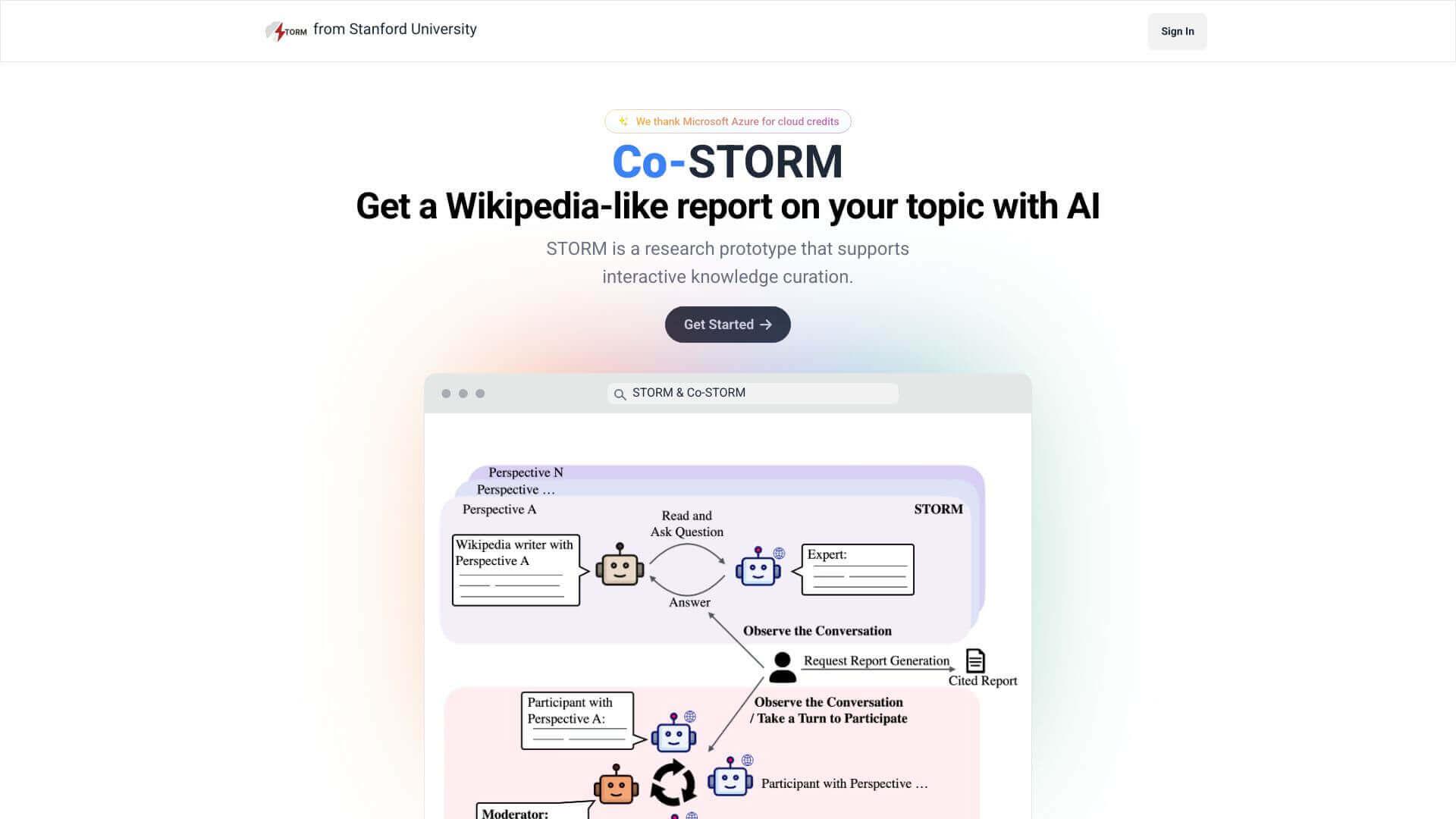
The project also includes Co-STORM, an interactive research system that allows people to participate in AI-generated discussions, guide the research direction, and explore information through a dynamically updated knowledge map.
Stanford STORM is particularly useful for researchers, students, educators, writers, and developers interested in AI-assisted research, structured knowledge discovery, and long-form content generation.
What Is Stanford STORM?
STORM stands for Synthesis of Topic Outlines through Retrieval and Multi-perspective Question Asking.
It is a research system designed to address a common limitation of AI-generated articles: producing fluent explanations without first conducting sufficiently broad research.
Rather than depending entirely on the knowledge already contained within a language model, STORM retrieves information from external sources and uses that information to guide the writing process.
The system approaches a topic from multiple viewpoints, generates research questions, and simulates conversations between a writer and knowledgeable experts.
These conversations help identify important subtopics, unanswered questions, and relevant evidence.
After gathering information, STORM creates a structured outline and uses the collected references to generate a long-form report.
Its output is intended to serve as a research-supported starting point rather than a fully verified publication-ready article.
Key Features of Stanford STORM AI
1. Automated AI Research
STORM automates several stages of online research.
When a user enters a topic, the system investigates relevant information, identifies potential research directions, and retrieves supporting sources.
This reduces the need to manually conduct every search before creating an initial report.
For example, someone researching renewable energy storage can use STORM to explore technologies, applications, challenges, and emerging research directions.
The resulting report provides an organized starting point for further investigation.
2. Wikipedia-Style Article Generation
One of STORM's primary capabilities is generating long-form articles organized similarly to encyclopedia entries.
The system creates a hierarchical outline before writing the final content.
This helps separate major subjects into sections and subsections rather than producing a single uninterrupted AI response.
Generated articles can include introductions, background information, technical explanations, supporting discussions, and references.
The structure makes the output useful for preliminary research and knowledge organization.
However, generated reports are not official Wikipedia articles and should not be treated as independently verified publications.
3. Multi-Perspective Question Generation
STORM uses a research method called perspective-guided question asking.
Instead of exploring a subject from only one angle, it identifies different perspectives that may be relevant.
For example, research about artificial intelligence in healthcare could involve technical, clinical, regulatory, economic, and ethical perspectives.
The system uses these viewpoints to formulate research questions and broaden the investigation.
This approach helps reduce the risk of overlooking important aspects of a complex topic.
4. Simulated Expert Conversations
STORM simulates conversations between an article writer and topic experts.
These AI-generated discussions help the system develop a deeper understanding of the subject.
The writer asks questions, receives source-grounded responses, and follows up when additional explanation is needed.
This process can uncover useful information that may not emerge from a single search query.
The simulated experts are AI agents, not necessarily real human specialists.
5. AI-Generated Research Outlines
Before writing a complete article, STORM generates a structured outline based on the information collected.
The outline organizes the topic into relevant sections and subtopics.
This provides a foundation for a coherent report and helps maintain logical connections between different areas of research.
Users can use the resulting structure as inspiration for educational articles, research summaries, or preliminary writing plans.
6. Source-Based Citations
STORM is designed to generate reports with citations.
The system retrieves information from external sources and attempts to associate claims with relevant references.
This is particularly valuable for research workflows where users need to understand where information originated.
However, the presence of a citation does not guarantee that the referenced source fully supports the associated statement.
Users should independently verify important facts, quotations, statistics, and references.
7. Co-STORM Interactive Research
Co-STORM extends the original system by introducing human-AI collaboration.
Instead of relying entirely on automated research, users can participate in a discussion with AI agents.
The system includes AI experts and a moderator that helps introduce useful questions and research directions.
Users can guide the conversation, ask additional questions, or explore specific aspects of the topic.
This makes Co-STORM useful for exploratory research where the user's interests may change as new information becomes available.
8. Dynamic Knowledge Maps
Co-STORM maintains a hierarchical knowledge map during research discussions.
As the conversation progresses, the map organizes discovered concepts and relationships.
This provides a visual overview of the information collected.
Knowledge mapping can be particularly helpful when researching unfamiliar subjects with many interconnected concepts.
9. Open-Source Research Framework
Stanford STORM is available as an open-source project.
Developers can explore its implementation, customize components, and integrate the underlying research workflow into their own applications.
The project provides a Python package named knowledge-storm.
Its modular design allows developers to work with different language models and information retrieval systems.
The public codebase also includes examples and a lightweight demonstration interface.
10. Customizable Research Pipeline
The STORM framework separates the research process into four main components:
Knowledge Curation: Collects information and supporting references about a topic.
Outline Generation: Organizes collected information into a hierarchical structure.
Article Generation: Produces written content using the outline and references.
Article Polishing: Refines the generated article for readability and presentation.
Developers can customize these modules according to their requirements.
This architecture makes STORM relevant for building specialized AI research and knowledge management applications.
How Does Stanford STORM Work?
STORM follows a structured research and writing workflow.
Step 1: Enter a Research Topic
Open the STORM research preview and provide a topic you want to investigate.
Choose a subject that benefits from detailed explanation, multiple viewpoints, and supporting references.
Step 2: Identify Research Perspectives
STORM identifies relevant viewpoints and questions associated with the topic.
These perspectives help guide the research beyond a basic overview.
Step 3: Retrieve Supporting Information
The system searches available external information sources and gathers material relevant to the generated questions.
Step 4: Simulate Research Conversations
AI agents conduct question-and-answer exchanges to explore the subject in greater depth.
Follow-up questions help identify additional details and connections.
Step 5: Generate a Structured Outline
STORM organizes the research findings into a hierarchical outline.
This establishes the structure of the final article.
Step 6: Generate the Research Report
The system produces a Wikipedia-style article using the outline and collected references.
Step 7: Review and Verify
Users should review the report, check citations, correct inaccuracies, and add any missing information.
For important work, the generated article should be treated as a draft requiring editorial verification.
STORM vs. Co-STORM: What's the Difference?
| Feature | STORM | Co-STORM |
|---|---|---|
| Primary Purpose | Automated research and article generation | Interactive knowledge exploration |
| Research Process | AI-led | Human-AI collaborative |
| Question Generation | Automated | Automated with user participation |
| Expert Discussions | Simulated AI conversations | Interactive multi-agent discussions |
| Knowledge Map | Not the central feature | Dynamic hierarchical map |
| Output | Structured report with citations | Curated knowledge and collaborative exploration |
| Best For | Research drafts and reports | Learning and guided investigation |
STORM is particularly useful when users want an automated first draft of a researched article.
Co-STORM is more suitable when users want to explore a subject interactively and influence the research process.
Practical Use Cases for Stanford STORM
Academic Research
Students and researchers can use STORM to explore unfamiliar subjects and identify relevant concepts.
Its source-based reports can help establish a preliminary understanding before reviewing original research publications.
Research Report Preparation
Professionals can use STORM to prepare initial background reports on complex topics.
The generated structure can reduce the time required to organize preliminary research findings.
Educational Content Development
Teachers and educational writers can use STORM to develop outlines and identify important concepts for learning materials.
Technical Topic Exploration
Developers and technical writers can investigate subjects such as machine learning, cybersecurity, cloud computing, and emerging technologies.
Knowledge Discovery
Co-STORM can support users who want to learn through interactive questions and progressively build an understanding of a topic.
AI Application Development
Developers can use the open-source framework as a foundation for customized research assistants, knowledge curation systems, and report generation workflows.
Long-Form Content Planning
Content writers can use STORM to discover subtopics and create structured article outlines.
However, the resulting content should be independently reviewed, rewritten where appropriate, and fact-checked before publication.
Stanford STORM Pricing and Availability
Stanford STORM is offered as a research preview, and its underlying framework is open source.
| Option | Pricing | Details |
|---|---|---|
| Stanford Research Preview | No public subscription price listed | Hosted research demonstration |
| Open-Source Framework | Free source code | Available through GitHub |
| Self-Hosted Implementation | Variable operating costs | Requires models, retrieval services, and infrastructure |
The open-source framework is distributed under the MIT license.
Developers running their own implementation may incur costs for AI model APIs, search providers, hosting, and computing resources.
The hosted research preview should not be confused with a commercial SaaS subscription offering guaranteed uptime or unlimited usage.
Benefits of Stanford STORM
Research-first content generation: Collects information before drafting long-form reports.
Multiple research perspectives: Explores topics from different angles.
Structured article creation: Produces organized reports with sections and references.
Citation support: Includes references that users can inspect and verify.
Interactive exploration: Co-STORM allows users to guide AI research discussions.
Knowledge visualization: Dynamic maps help organize complex information.
Open-source availability: Developers can inspect and customize the framework.
Modular architecture: Supports different research and language model configurations.
Limitations of Stanford STORM
STORM is a research prototype rather than a fully managed commercial research platform.
Generated articles may contain factual inaccuracies, incomplete explanations, unsupported citations, or missing perspectives.
The Stanford research team explicitly notes that generated reports may require substantial editing before publication.
Results also depend on the quality of retrieved sources and the language models used.
The hosted research preview has usage terms that permit collection of user inputs for research purposes. Users should avoid submitting personally identifiable or confidential information.
Developers using the open-source version need technical knowledge to configure the environment, language models, retrieval systems, and API credentials.
STORM can accelerate early research, but it does not replace expert review, source verification, or academic research standards.
Frequently Asked Questions
What is Stanford STORM AI?
Stanford STORM is an AI research system that gathers online information, generates structured outlines, and produces Wikipedia-style reports with citations.
Is Stanford STORM free?
The project provides an open-source framework, and Stanford offers a hosted research preview. Self-hosting may involve infrastructure and API costs.
What does STORM stand for?
STORM stands for Synthesis of Topic Outlines through Retrieval and Multi-perspective Question Asking.
Who developed Stanford STORM?
STORM was developed by researchers associated with Stanford University's OVAL laboratory.
Can STORM generate research reports?
Yes. The system is designed to generate structured reports based on retrieved information and supporting references.
Does STORM provide citations?
Yes. It attempts to include citations to retrieved sources, although users should verify their accuracy and relevance.
What is Co-STORM?
Co-STORM is an interactive extension that allows people to collaborate with AI agents during knowledge exploration.
Can I use STORM for academic research?
Yes, particularly for preliminary research and topic exploration. Generated content should be verified against reliable original sources.
Is Stanford STORM open source?
Yes. Its framework is available through GitHub under the MIT license.
Can developers build applications using STORM?
Yes. Developers can customize the research pipeline and integrate its components into their own applications, subject to the project's license and dependencies.
Does STORM replace human researchers?
No. It helps automate information gathering and draft preparation but still requires human judgment and fact-checking.
Is STORM suitable for SEO content writing?
It can support research and outline development. However, generated articles should be fact-checked and substantially edited to provide original value before publication.
Final Verdict: Is Stanford STORM Worth Trying?
Stanford STORM is an interesting open-source AI research system for people who want to go beyond simple chatbot answers.
Its research-first architecture, multi-perspective questioning, simulated expert conversations, and citation-supported article generation make it useful for exploring complex subjects.
Co-STORM adds another dimension by allowing users to participate directly in the research process and visualize information through knowledge maps.
For students, researchers, educators, technical writers, and developers, STORM offers a practical starting point for research-assisted writing and knowledge discovery.
Its greatest value lies in accelerating the early stages of research while keeping users responsible for reviewing the final information.
मूल्य निर्धारण मॉडल और योजनाएं
Visit the official website for current tier pricing and enterprise quotes.
Community Reviews & Ratings
Independent Editorial Evaluation
This score reflects our staff's hands-on testing across pricing, features, and reliability. No community reviews submitted yet. Have you used Storm by Stanford? Be the first to share your experience!
No user reviews submitted yet.
Have you tried Storm by Stanford? Be the first to share your experience!
Want to review Storm by Stanford?
Sign in to leave a verified rating and feedback. Only verified members can rate tools to prevent spam.
Log In to Write a Review →के शीर्ष विकल्प Storm by Stanford
Top-rated alternative AI software in Research & Data Analysis tested by our team.
View In-Depth Storm by Stanford Alternatives & Feature Matrix →

Top Prompts & Workflows for Storm by Stanford
Save time and extract maximum performance from Storm by Stanford with these tested, high-yield system prompts:
You are an expert specialist in Research & Data Analysis. Analyze the following challenge and break it down into a 3-step high-yield execution plan: [Insert Project / Task Here]. Optimize for minimum latency and zero hallucinations.
Critically inspect the following output created by Storm by Stanford: [Insert Content Here]. Identify edge cases, logic gaps, or tone inconsistencies, and return a polished, production-grade rewrite.
Adopt the persona of a senior technical lead. Provide a step-by-step workflow on integrating Storm by Stanford with our existing stack. List recommended settings, shortcuts, and common pitfalls to avoid.
Embed the "Featured on AI Pulse" Badge
Are you the builder of Storm by Stanford? Showcase your official editorial verification by embedding our high-res dynamic SVG badge on your website footer or documentation.