

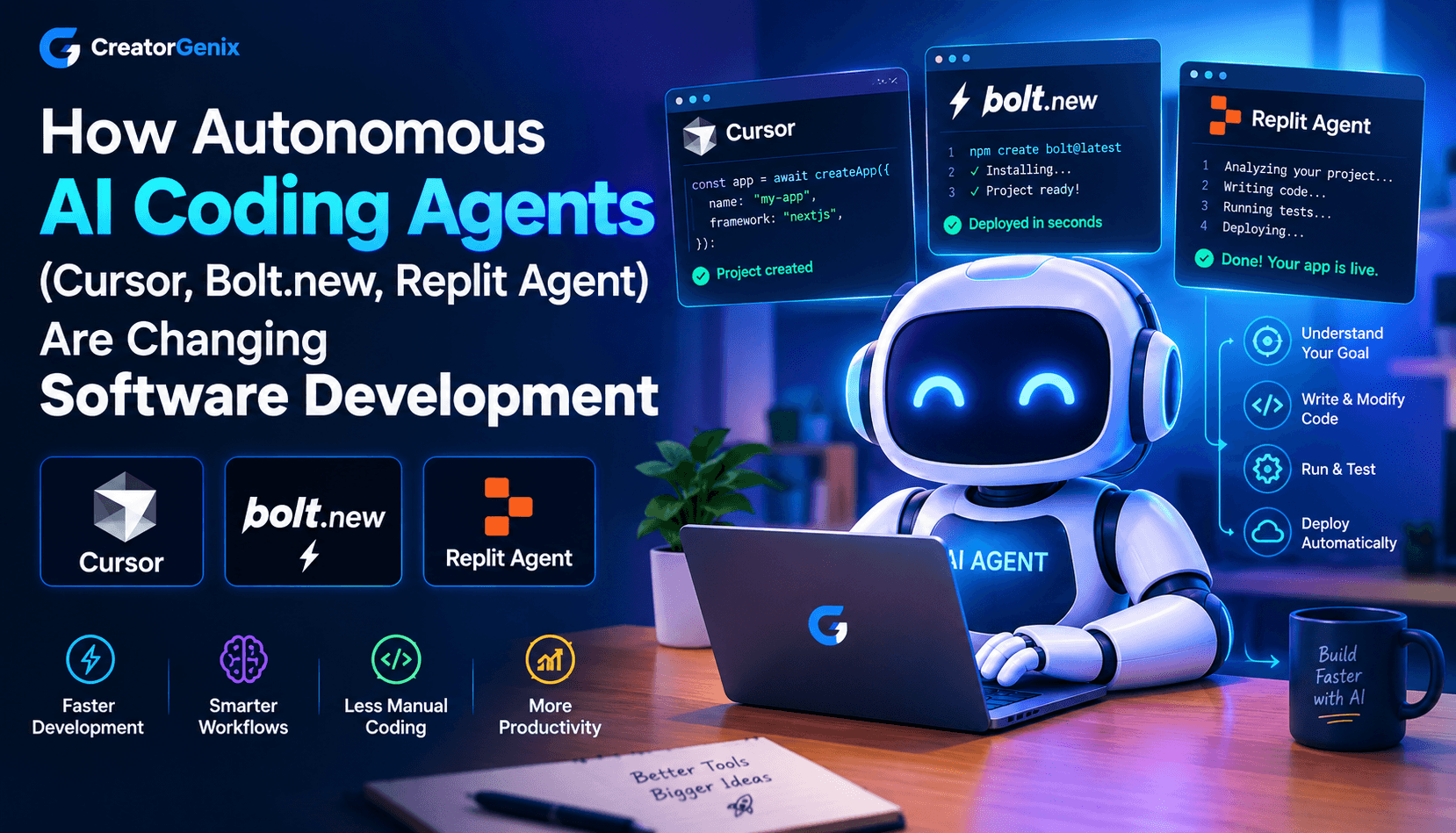
The software engineering profession is witnessing its most profound paradigm shift since the creation of the graphical integrated development environment (IDE). For several years, artificial intelligence in programming was restricted to inline tab-completions—predicting the next few tokens of a function. In 2026, we have definitively transitioned into the era of autonomous agentic software engineering.
The Evolution: Autocomplete vs Copilots vs Autonomous Agents
To appreciate this architectural evolution, consider the three distinct generations of developer tooling:
- Generation 1 (Tab Autocomplete - 2021): Tools like early GitHub Copilot suggested single lines or regex patterns based on immediate file context.
- Generation 2 (Contextual Chat - 2023): Side-by-side chat windows allowed developers to highlight snippets and ask for explanations or unit tests.
- Generation 3 (Autonomous Agents - 2026): Systems that read the entire project repository, formulate a multi-step plan, modify 15 files simultaneously, run compiler tests, inspect terminal errors, self-heal bugs, and deploy live applications.
1. Cursor AI: The Agentic Powerhouse for Pro Developers
Built as a custom fork of Visual Studio Code, Cursor maintains 100% compatibility with existing extensions and keybindings while introducing local vector codebase indexing. Its flagship feature, Composer (activated via Ctrl+I), can orchestrate massive architectural refactors across multiple files in a single pass. Developers can reference specific symbols with @Codebase or @Docs, allowing the AI to pull accurate framework documentation directly into the context window.
2. Bolt.new: Full-Stack Web Development in the Browser
Developed by StackBlitz, Bolt.new eliminates local environment configuration entirely. Leveraging WebContainers technology, Bolt runs an entire Node.js server environment inside your web browser. You can prompt: "Build a collaborative Kanban board with Supabase authentication and Tailwind styling", and Bolt will scaffold the repository, install npm dependencies, compile the frontend, and run the server in a live preview pane within 90 seconds.
3. Replit Agent: Autonomous Cloud Software Builder
Replit Agent focuses on autonomous end-to-end delivery. Given high-level product specifications, it provisions PostgreSQL databases, scaffolds backend APIs (Flask, FastAPI, Express), writes frontend user interfaces, and autonomously executes terminal commands. If an npm install fails or a database migration triggers an error, the agent reads the stderr trace and rewrites the offending code until the test passes.
How Senior Engineers Leverage AI Agents Efficiently
While novice programmers sometimes assume AI agents eliminate the need for coding fundamentals, top senior software architects use agents differently:
- Spec-Driven Development: Writing thorough architectural specifications (Markdown files detailing data schemas, API routes, and edge cases) before prompting the agent.
- Micro-Commit Hygiene: Using tools like Aider that automatically create atomic Git commits for every functional change, allowing instant rollbacks if an agent makes an errant assumption.
- Rigorous Automated Testing: Requiring the agent to write comprehensive end-to-end (Playwright) and unit (Jest/PyTest) tests before declaring a feature complete.
Conclusion
Autonomous AI coding agents do not replace software engineers; they elevate them to engineering managers. The bottleneck in software creation is no longer the physical speed of typing syntax—it is system design, architectural clarity, and product vision.
Practical Step-by-Step Implementation Framework
Transitioning from theoretical knowledge to real-world application requires a disciplined workflow. Based on empirical testing across production environments, we recommend structuring your implementation through the following iterative phases:
- Audit & Baseline Metrics: Before introducing artificial intelligence into any workflow, measure current time-to-completion, error rates, and operational bottlenecks. Establishing quantifiable baselines ensures you can accurately measure ROI.
- Prompt Constraint Architecture: Formulate prompts using structured delimiters (such as XML tags or Markdown headings) to separate instructions, contextual references, and output format requirements. Explicit negative constraints (e.g. "Do not use marketing jargon; provide only runnable syntax") dramatically reduce iteration cycles.
- Automated Quality Gates: Never deploy raw, unverified AI outputs directly to end users. Implement multi-layered validation checks—such as automated linting for code, plagiarism scanners for written copy, and factual citation verification for analytical reports.
- Continuous Feedback & Model Calibration: Foundation models evolve rapidly. Re-evaluate your chosen platform quarterly against newly released open-weight and proprietary benchmarks to capitalize on price reductions and capability leaps.
Enterprise Security, Privacy & Compliance Considerations
When scaling artificial intelligence across commercial teams, data governance and intellectual property sovereignty become paramount concerns. Key compliance safeguards include:
- Zero Data Retention (ZDR) Guarantees: Ensure enterprise contracts explicitly prevent model providers from storing or utilizing proprietary company data, codebases, or customer records for foundational model training.
- Role-Based Access Control (RBAC): Enforce granular workspace permissions so team members only access AI pipelines relevant to their departmental responsibilities.
- Audit Logging & Traceability: Maintain comprehensive logs of all automated AI generations, API requests, and human reviews to satisfy SOC2, HIPAA, and GDPR regulatory requirements.
Frequently Asked Questions (FAQ)
What is the most common mistake organizations make when adopting AI in 2026?
The most frequent pitfall is treating artificial intelligence as a magic plug-and-play solution without establishing structured workflows, domain-specific context, or human editorial review gates. AI delivers exponential leverage only when paired with clear operational systems.
How can teams verify the factual accuracy of AI-generated content?
Always cross-reference factual claims against primary documentation, audited financial reports, or peer-reviewed literature using citation-backed answer engines like Perplexity AI or Consensus. Never rely on zero-shot model outputs for critical numbers, legal clauses, or medical advice.
Final Summary & Strategic Takeaways
The technological landscape in 2026 rewards organizations and creators who master human-AI synergy. By combining human creativity, strategic judgment, and domain expertise with the raw computational speed and synthetic power of artificial intelligence, you can achieve unprecedented operational scale while maintaining exceptional quality standards.