

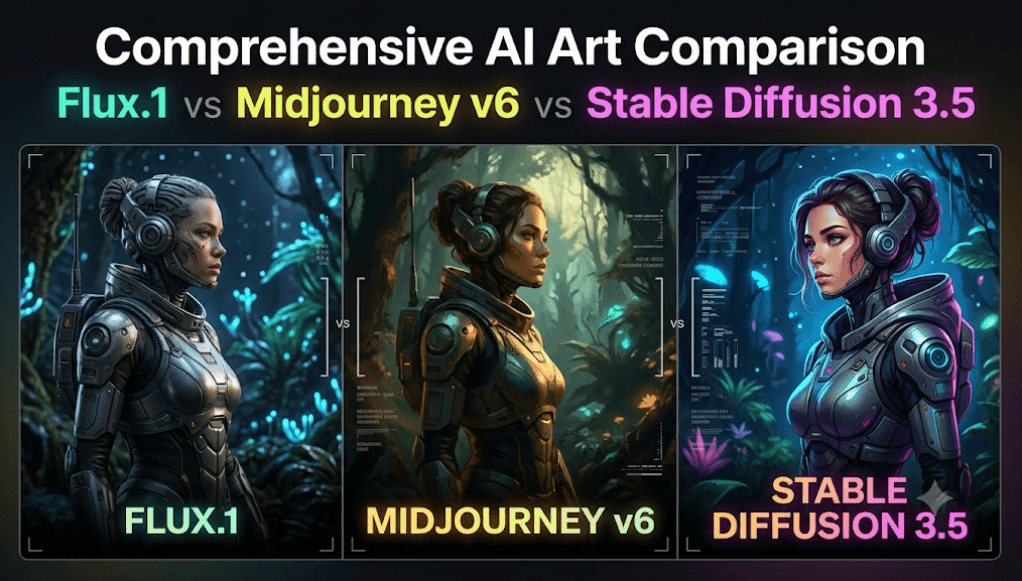
Generative visual AI has progressed from abstract novelty to an indispensable production tool for concept artists, game developers, and marketing directors. Today, three foundation models dominate the generative art conversation: Flux.1 by Black Forest Labs, Midjourney v6, and Stable Diffusion 3.5 by Stability AI.
1. Flux.1: The Prompt Adherence and Text Champion
Created by the pioneering engineers behind the original Stable Diffusion architecture, Flux.1 utilizes a 12-billion-parameter flow-matching architecture. Its greatest strength is its ability to follow long, intricate prompts with photographic accuracy. If you request a scene with four distinct people holding specific colored items while standing in front of a vintage cinema with an exact movie title on the marquee, Flux renders the scene with astonishing fidelity.
2. Midjourney v6: Unmatched Cinematic Aesthetic
For high-end commercial artwork, luxury fashion concepting, and cinematic portraits, Midjourney v6 remains the undisputed aesthetic benchmark. It naturally injects editorial lighting, film grain, and realistic human skin imperfections (freckles, pores, wrinkles) without requiring complex prompt engineering. Accessible via Discord and its web interface, Midjourney is the tool of choice for art directors.
3. Stable Diffusion 3.5: Local Control and Customization
For developers, indie studios, and creators who require complete offline privacy and custom model training, Stable Diffusion 3.5 is paramount. Released under a permissive Community License, SD3.5 can be run locally on NVIDIA GPUs via ComfyUI. Creators can train custom LoRAs (Low-Rank Adaptations) to teach the model proprietary corporate mascots, specific brand color styles, or unique artistic aesthetics.
Feature Breakdown Matrix
| Metric | Flux.1 | Midjourney v6 | Stable Diffusion 3.5 |
|---|---|---|---|
| Text Rendering | ⭐⭐⭐⭐⭐ (Flawless) | ⭐⭐⭐⭐ (Very Good) | ⭐⭐⭐⭐ (Good) |
| Cinematic Aesthetic | ⭐⭐⭐⭐ (Photorealistic) | ⭐⭐⭐⭐⭐ (Unrivaled) | ⭐⭐⭐⭐ (High fidelity) |
| Local Offline GPU | Yes (Schnell & Dev) | No (Cloud only) | Yes (ComfyUI / WebUI) |
| Fine-Tuning / LoRA | Rapidly growing | Style Reference codes | ⭐⭐⭐⭐⭐ (Massive ecosystem) |
Verdict: Which Should You Choose?
Choose Midjourney v6 if you want instant, visually stunning editorial imagery without managing technical settings. Choose Flux.1 if your work demands precise text on signs, logos, or complex multi-subject interactions. And choose Stable Diffusion 3.5 if you need total local privacy, zero subscription fees, and custom model fine-tuning.
Practical Step-by-Step Implementation Framework
Transitioning from theoretical knowledge to real-world application requires a disciplined workflow. Based on empirical testing across production environments, we recommend structuring your implementation through the following iterative phases:
- Audit & Baseline Metrics: Before introducing artificial intelligence into any workflow, measure current time-to-completion, error rates, and operational bottlenecks. Establishing quantifiable baselines ensures you can accurately measure ROI.
- Prompt Constraint Architecture: Formulate prompts using structured delimiters (such as XML tags or Markdown headings) to separate instructions, contextual references, and output format requirements. Explicit negative constraints (e.g. "Do not use marketing jargon; provide only runnable syntax") dramatically reduce iteration cycles.
- Automated Quality Gates: Never deploy raw, unverified AI outputs directly to end users. Implement multi-layered validation checks—such as automated linting for code, plagiarism scanners for written copy, and factual citation verification for analytical reports.
- Continuous Feedback & Model Calibration: Foundation models evolve rapidly. Re-evaluate your chosen platform quarterly against newly released open-weight and proprietary benchmarks to capitalize on price reductions and capability leaps.
Enterprise Security, Privacy & Compliance Considerations
When scaling artificial intelligence across commercial teams, data governance and intellectual property sovereignty become paramount concerns. Key compliance safeguards include:
- Zero Data Retention (ZDR) Guarantees: Ensure enterprise contracts explicitly prevent model providers from storing or utilizing proprietary company data, codebases, or customer records for foundational model training.
- Role-Based Access Control (RBAC): Enforce granular workspace permissions so team members only access AI pipelines relevant to their departmental responsibilities.
- Audit Logging & Traceability: Maintain comprehensive logs of all automated AI generations, API requests, and human reviews to satisfy SOC2, HIPAA, and GDPR regulatory requirements.
Frequently Asked Questions (FAQ)
What is the most common mistake organizations make when adopting AI in 2026?
The most frequent pitfall is treating artificial intelligence as a magic plug-and-play solution without establishing structured workflows, domain-specific context, or human editorial review gates. AI delivers exponential leverage only when paired with clear operational systems.
How can teams verify the factual accuracy of AI-generated content?
Always cross-reference factual claims against primary documentation, audited financial reports, or peer-reviewed literature using citation-backed answer engines like Perplexity AI or Consensus. Never rely on zero-shot model outputs for critical numbers, legal clauses, or medical advice.
Final Summary & Strategic Takeaways
The technological landscape in 2026 rewards organizations and creators who master human-AI synergy. By combining human creativity, strategic judgment, and domain expertise with the raw computational speed and synthetic power of artificial intelligence, you can achieve unprecedented operational scale while maintaining exceptional quality standards.