
The Death of the English-Only Internet
For decades, digital software products, online courses, marketing campaigns, and corporate video libraries were built under a pervasive geographic assumption: that English alone was sufficient to capture the global market. While English remains a major language of international commerce, over 75% of global internet consumers refuse to make purchasing decisions on websites that do not offer native localization in their mother tongue.
Historically, expanding a digital business into Latin America, Europe, or East Asia required hiring expensive translation agencies, contracting voice actors for local studio dubbing, and spending tens of thousands of dollars per market. A video training library consisting of fifty hours of content required months of scheduling, recording, and manual audio mixing.
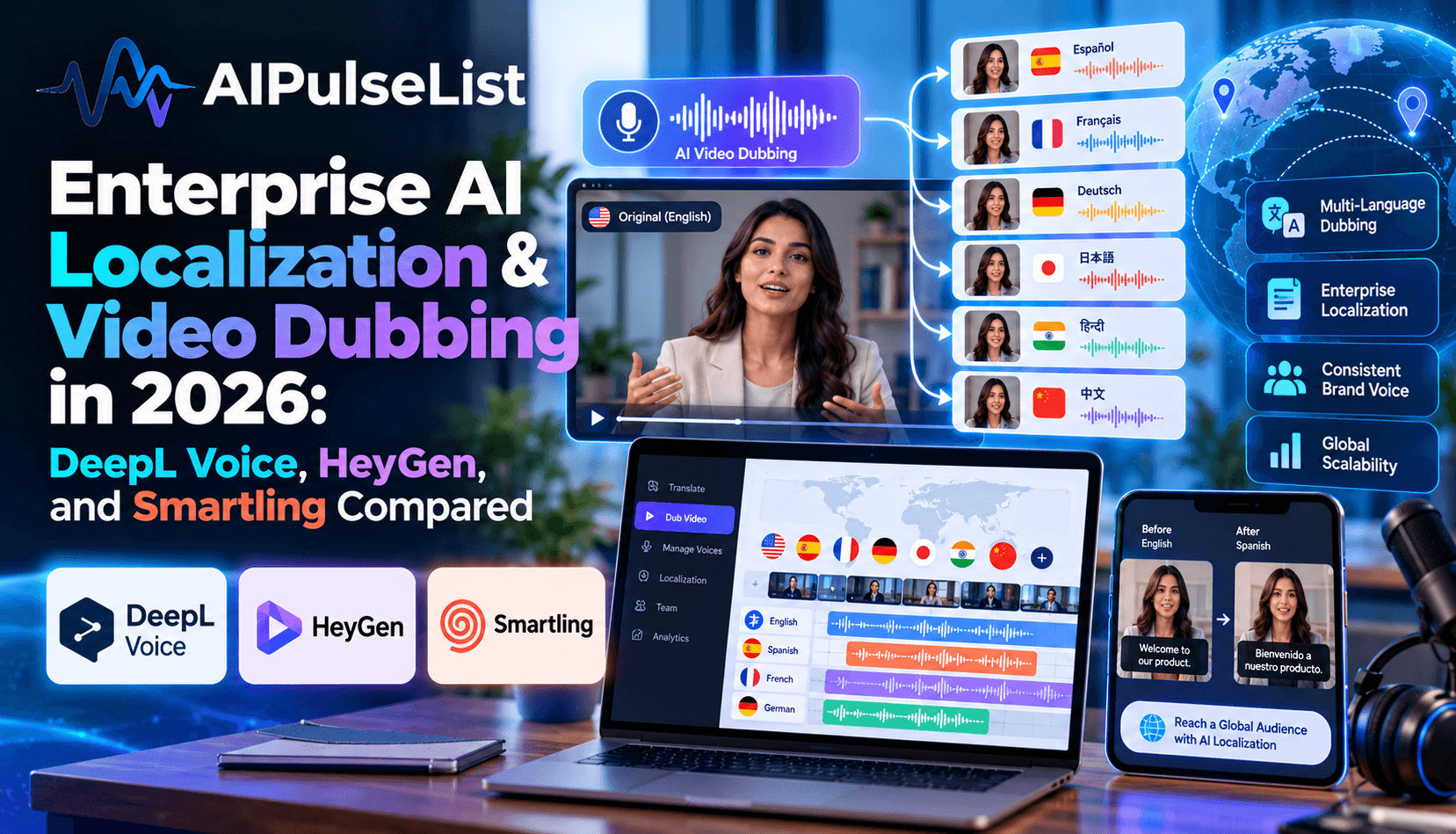
In 2026, artificial intelligence has permanently dismantled language barriers. Advanced neural machine translation models preserve subtle corporate terminology and idiomatic context, while cutting-edge generative video dubbing engines translate spoken dialogue, clone the speaker's original vocal timbre, and synthetically re-animate the speaker's mouth movements with photorealistic lip synchronization in over 50 languages.
💡 Pro-Tip for Global Teams:
Discover verified localization software in our Translation & Localization AI Directory to find specialized audio dubbing tools, neural APIs, and translation workflows.
The Anatomy of Modern AI Localization
High-grade localization requires synchronizing three distinct technological layers:
- Context-Aware Neural Machine Translation (NMT): Preserving industry jargon, technical acronyms, and brand names (e.g., ensuring "AI Pulse Directory" is never translated literally into foreign gibberish).
- Zero-Shot Voice Timbre Cloning: Capturing the unique vocal frequency, warmth, pitch, and emotional cadence of the original speaker, so an executive speaking in English sounds unmistakably like themselves when speaking fluent German, Japanese, or Portuguese.
- Neural Lip Synchronization (Lip-Sync): Modifying the speaker's mouth and facial muscle pixels on the original video footage so the lip movements match the phonemes of the newly translated audio with zero uncanny-valley artifacts.
1. DeepL Voice & Enterprise Neural Translation
Founded in Germany, DeepL has long been acknowledged by professional linguists as superior to Google Translate in nuance, tone accuracy, and European language subtlety. In 2026, DeepL Voice expands this linguistic mastery into real-time spoken translation and video subtitles.
Standout Strengths:
- Unsurpassed Grammatical Nuance: Flawlessly captures formal vs. informal pronouns (e.g., "tu" vs. "vous" in French, "du" vs. "Sie" in German), preventing corporate marketing gaffes.
- Custom Glossaries & Terminology Dictionaries: Allows enterprises to upload proprietary translation glossaries, guaranteeing consistent product naming across millions of translated words.
- Bank-Grade Data Privacy: Certified ISO 27001 with strict European data processing terms guaranteeing that enterprise translation payloads are immediately deleted after processing.
2. HeyGen: The Leader in Photorealistic Video Dubbing & Lip Sync
HeyGen took the digital media world by storm with its groundbreaking video translation technology, becoming the essential tool for international marketing directors, educators, and enterprise training leaders.
Standout Strengths:
- Photorealistic Lip Synchronization: Accurately re-renders mouth movements so that the speaker appears to have filmed the video natively in the target language.
- Multi-Speaker Identification: Automatically detects when multiple participants are speaking in a video, assigning each person a distinct voice-cloned profile in the translated output.
- Interactive AI Avatars: Can generate complete training videos from text scripts using photorealistic studio avatars, eliminating the need to film new footage when updating training modules.
3. Smartling: The Enterprise Localization Management Cloud
While DeepL handles translation and HeyGen dominates video dubbing, Smartling is the enterprise orchestration platform that connects translation models directly into production codebases, mobile apps, and CMS platforms.
Standout Strengths:
- Continuous DevOps Integration: Plugs directly into GitHub, GitLab, and Contentful. When software engineers commit new UI strings in English, Smartling automatically routes them through neural AI translation models, stages human linguistic reviews, and merges localized strings back into code in hours.
- Visual In-Context Translation: Translators view the live website interface in real time, preventing broken layouts caused by German or Russian words that are 40% longer than their English equivalents.
- Quality Estimation Scoring (MQM): Uses machine learning to evaluate translation quality automatically, flagging which strings require human review and which can be pushed live autonomously.
Comparative Evaluation Table
| Platform Solution | Core Competency | Language Support | Voice & Video Dubbing | Best Suited For |
|---|---|---|---|---|
| DeepL | High-Precision Text & Document Translation | 35+ Major Languages | Subtitles & Real-time voice captions | Enterprise documentation, legal & marketing text |
| HeyGen | Voice-Cloned Video Dubbing & Lip Sync | 50+ Languages & Accents | Full Photorealistic Lip-Sync Video | Course creators, YouTube channels & corporate training |
| Smartling | Continuous Software & CMS Localization | 150+ Languages | Subtitling & Multimedia Asset Management | Global SaaS platforms & multi-country e-commerce |
The Technical Mechanics: Solving the German Syllable Expansion Problem
One of the most persistent technical hurdles in automated video dubbing is linguistic expansion. When an English sentence like "Please submit your quarterly tax report" is translated into German, the resulting sentence—"Bitte reichen Sie Ihren vierteljährlichen Steuerbericht ein"—contains significantly more syllables and takes 30% longer to speak at a natural cadence.
In 2026, generative localization engines solve this challenge through Dynamic Acoustic Time-Warping and Context-Aware Script Condensation:
- Script Token Rewriting: The translation LLM is explicitly constrained to match the phoneme duration of the original audio, selecting concise synonyms that fit the exact timestamp boundaries.
- Non-Linear Audio Compaction: Pauses between words are algorithmically compressed by microseconds while preserving natural vocal pitch, preventing the audio from sounding artificially sped up.
- Diffusion In-Painting: The speaker's neck, jawline, and mouth are re-rendered frame-by-frame, ensuring seamless naturalism that passes the most demanding broadcast television standards.
Strategic Blueprint: Launching in 5 Global Markets in 30 Days
To scale your organization's content globally without runaway costs, execute this standardized deployment sequence:
- Step 1: Identify Target Languages via Analytics: Analyze Google Analytics traffic and inbound customer requests to pinpoint high-demand unserved territories (e.g., German, Spanish, Japanese, Brazilian Portuguese).
- Step 2: Build Brand Glossaries in DeepL: Define untouchable brand names, product trademarks, and technical terms in custom glossary files before executing any automated translation.
- Step 3: Localize Core High-Converting Assets First: Translate landing pages, pricing grids, and checkout flows before translating secondary documentation.
- Step 4: Dub Pillar Video Content with HeyGen: Convert your primary 90-second product demo video into localized versions with authentic voice cloning and lip synchronization.
- Step 5: Enforce Native In-Country Spot-Checking: Contract native-speaking freelance editors to spend 30 minutes validating the tone, currency formats, and cultural appropriateness of high-traffic pages before running ad campaigns.
Conclusion
In 2026, geographic boundaries no longer restrict digital commerce. The combination of neural machine translation, voice cloning, and generative video dubbing gives forward-thinking creators and businesses a superpower: the ability to communicate with the world in its own language, instantly and authentically. The future belongs to those who speak to the entire world, not just their home market.